MARKET VIEWPOINT
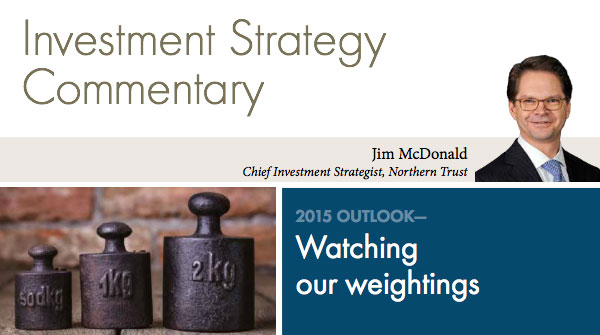

Asset class returns were much more differentiated in 2014 than in 2013, with yield-oriented assets and U.S. equities being the standout performers. We entered 2014 favoring risk, but we made several changes as the year progressed. Global growth was modestly disappointing in 2014, with the United States having the best momentum, while Europe and Japan fell short. Inflation trends continued to undershoot forecasts, most markedly in Europe. We believe this will lead to further divergence in central bank policy in 2015, with a likely follow-through impact on currencies. While we enter 2015 with a risk position that still favors risk-taking, our risk appetite is lower than a year ago. The downgrade of our expectations for growth outside the United States is why we are watching our weightings. Our primary risk cases are the outlook for G-2 (U.S. and Chinese) economic growth, the potential for heightened financial market volatility surrounding monetary policy normalization and geopolitical risks emanating from the conflict between Russia and the West.
CLICK FOR LARGER IMAGE
While the Federal Reserve has ended its quantitative easing (QE) program and is contemplating its first rate hike in 2015, both the European Central Bank (ECB) and the Bank of Japan (BOJ) are conjuring up additional stimulus as disinflation is widespread and unemployment in Europe has shown little improvement. The 2014 U.S. midterm elections highlighted voters’ disaffection with political leadership. Britain, Canada and Spain are among the important elections in 2015 that are likely to further crystalize this dissatisfaction and define the political reaction. Geopolitical risks are likely to remain elevated in 2015, with plunging oil prices raising fiscal uncertainties and the Russia-Ukraine conflict unsettled.
CLICK FOR LARGER IMAGE
Macro theme review
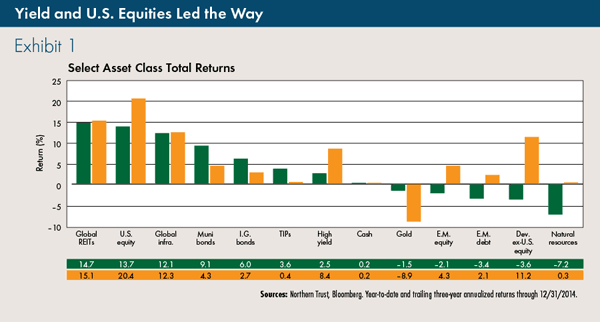
Part of our 2015 outlook is a review of how our long-term capital market assumption themes, as published each summer in our Five-Year Outlook paper, are developing. These themes drive the forward-looking portion of our “forward-looking, but historically aware” approach to strategic asset allocation (five-year time horizon). They also serve as a useful template for our (one-year time horizon) outlook and asset allocation positioning. Exhibit 2 details five of our key themes from the 2014 edition and how those themes are progressing.
Our theme of Enduring and Maturing Global Growth is central to our strategic outlook. It continues to be in play, providing for a continuation of accommodative monetary policy, low interest rates, strong profit margins and elevated equity valuations. This supports our base case of equity market appreciation in line with revenue growth and our belief in a moderate overweight to risk assets. At risk, however, is our expectation for “maturing” emerging market growth—wherein concerns over a faster pace of slowdown impair the outlook for emerging market equities. U.S. bank credit has overcome some of the regulatory obstacles noted in Central Bank Paradox, but inflation is steady and inflation expectations have fallen—so far validating the Developed Market Inflation Sponge theme. We remain slightly cautious with real assets given the disinflationary environment, but we are cognizant that our balanced assessment of geopolitical risks may be too benign, as social unrest in oil-exporting emerging markets may increase geopolitical concerns. Fears over bubbles have proven to be mostly hyperbole thus far with elevated valuations justified given the interest rate environment.
Fixed income
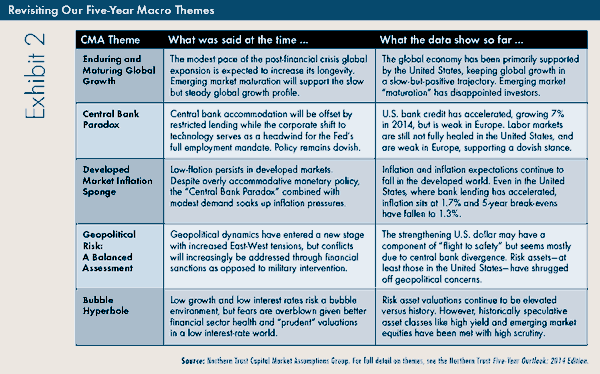
When thinking about the outlook for interest rates, we focus on both traditional drivers (the outlook for growth and inflation) and also technical factors (other factors affecting the supply or demand for fixed income). The sluggish global growth environment, alongside benign inflation data, has supported global fixed income for the last several years. In addition, the quantitative easing programs of the Fed, BOE and BOJ have suppressed global rates, and the ECB has also contributed to the low rate environment—although they have yet to actually implement QE. With our muted growth expectations for both Europe and Japan in place for 2015, we see little upside risk to their interest rates. This highlights the relative attractiveness of rates in Australia, the United States and the United Kingdom (as shown in Exhibit 3). This helps address the question of who will step in to buy U.S. bonds now that the Fed has completed its QE program. To wit, foreign investors bought $284 billion of U.S. Treasuries in the first nine months of 2014, compared with just $83 billion in the same period during 2013. We think the relative attractiveness of U.S. yields limits the upside risk to U.S. rates during the next several years.
We do not expect a serious negative reaction in bond prices to the commencement of the tightening cycles in the United States or the United Kingdom. We believe both central banks will have sufficient latitude to be patient in their pace of rate hikes, and we expect the eventual rate hikes will be less than that priced into current bond prices. This should set the stage for continued positive investment returns from investment-grade bonds as was experienced during the 1986, 1988 and 2004 rate hike cycles (see Exhibit 3). In the U.S. municipal bond market, last year’s undervaluation has been rectified through the market-leading 9% return of municipal bonds. With municipal credit spreads remaining tight, we favor higher-quality issuers going into 2015. The recent increase in U.S. high-yield spreads has boosted the current yield-to-worst to 7.1%. We think this creates sufficient cushion for the eventual default and restructuring of some high-leveraged energy company bonds.
CLICK FOR LARGER IMAGE
Equities
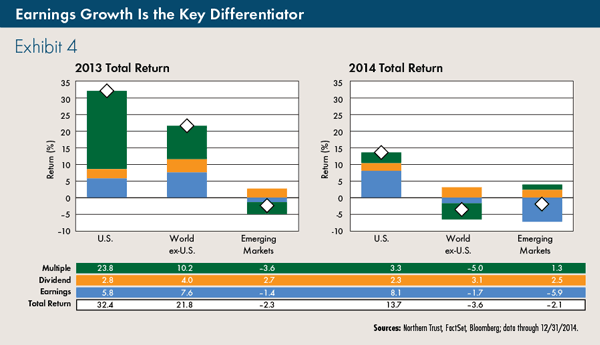
The year 2014 appears to have ended up similarly to 2013, in that U.S. equities led the developed and emerging markets. However, it was a much tougher market environment as the easy multiple expansion of 2013 is behind us. The bull market that began in October 2011 led to significant valuation expansion, as is typically the case, and further advances will rely on earnings growth and dividends. As long as growth remains good, but not great, corporate management teams will likely continue to use their excess capital for dividend increases and share repurchases. The S&P 500 Index price-to-earnings ratio reached 18.3 at the end of November (surpassing the historic median of 16.6), but the current dividend yield of 2.0% looks reasonable compared with the 10-year Treasury yield of 2.12%. These comparisons grow more extreme in Europe and Japan, where dividend yields of 3.8% in Europe compare with the German 10-year at 0.54% and Japanese yields of 1.5% also dwarf their 10-year yields of 0.32%. Our base case forecast for 2015 is for little valuation change, with the S&P 500 outperforming emerging markets, and emerging markets outperforming developed markets outside the United States. It is important to note that these forecasts assume constant currency values—and if the dollar keeps rallying, the markets outside the United States will see a commensurate reduction in their dollar-based returns.
A key question investors are wrestling with is how stocks will perform once central bank policy starts to normalize.
With the Fed first up to raise rates, we can use it as a template for other developed markets. In the last five rate cycles, U.S. stocks generated a positive return four times in the one-year period that commenced six months before the first rate hike (this accounts for the discounting mechanism in the stock market). The one exception was the 1988 rate cycle, for which the performance timeframe captures the 1987 crash that was unrelated to the rate cycle. We think that the Fed will only increase interest rates in an environment of durable growth, and will be unlikely to surprise the markets. Therefore, while the rate hikes could increase volatility in the markets, they should not derail equity prices in an expanding economy.
CLICK FOR LARGER IMAGE
Conclusion
There are three key themes that are driving our asset allocation views for 2015. First, we have conviction that U.S. assets are attractive in the current environment. U.S. growth is outpacing its peers, the central bank is gaining confidence to start normalizing policy, and the United States is a geopolitical safe haven. Second, we see divergent growth patterns due to uncoordinated global policy. This may lead to increased volatility, but it will also push monetary policy toward accommodation and keep interest rates low. Finally, the continuing low interest rate environment means there is a high bar for taking out portfolio insurance by investing in cash or short duration bonds.
What kind of market environment may unfold in 2015? We do expect an increase in volatility tied to the continued upheaval in the oil markets and also driven by expectations toward rate hikes from the Fed and the Bank of England. Slowing growth in Europe, Japan and China is why we are watching our weightings as we enter the new year. We think the recent increase in yields in U.S. high-yield bonds improves their prospective returns. We believe this outlook justifies a favorable view of U.S. high-yield bonds, especially as the return potential is above what we expect from developed non-U.S. and emerging market equities. An unexpected downturn from U.S. or Chinese growth remains our primary risk case, along with concerns about Russian/Western relations and market volatility stemming from monetary policy developments.
Barclays Capital U.S. Government/Credit Index includes securities in the Government and Credit Indices. The Government Index includes treasuries (i.e., public obligations of the U.S. Treasury that have remaining maturities of more than one year) and agencies (i.e., publicly issued debt of U.S. Government agencies, quasi-federal corporations, and corporate or foreign debt guaranteed by the U.S. Government). The Credit Index includes publicly issued U.S. corporate and foreign debentures and secured notes that meet specified maturity, liquidity, and quality requirements.
Barclays Capital U.S. Long Government/Credit Index is the Long component of the U.S. Government/Credit index—including debt issuance with maturities greater than 10 years.
S&P 500® Index is an unmanaged index consisting of 500 stocks and is a widely recognized common measure of the performance of the overall U.S. stock market.
It is not possible to invest directly in an index.
Price-to-Book Ratio is a ratio used to compare a stock’s market value to its book value. It is calculated by dividing the current price of the stock by the latest quarter’s book value per share.
Yield-to-maturity is the rate of return anticipated on a bond if it is held until the maturity date.