- Who We Serve
- What We Do
- About Us
- Insights & Research
- Who We Serve
- What We Do
- About Us
- Insights & Research
Unlocking Value With Network Alpha
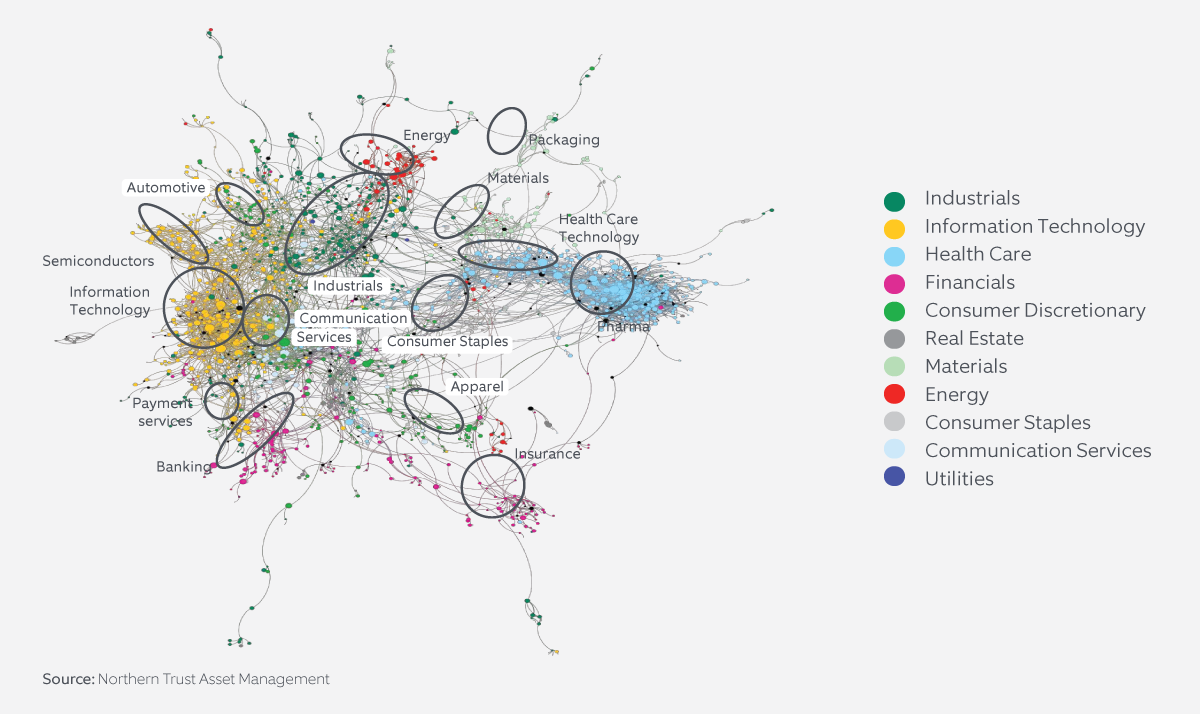
Network Alpha applies a network lens to equity investing - mapping how companies are connected through supply chains, technology linkages, business peers, competitive and other relationships - to add information that traditional, company‑by‑company analysis may miss. Advances in NLP/LLMs make it possible to extract these links at scale from corporate filings and other primary sources, then translate them into investable signals.
This article draws on and briefly summarizes the Research Insights paper “Uncovering Alpha in the Networked Economy” (de Lange, e.a., 2025) which lays out: how we build company networks from primary data, where text‑based networks add value, and how network signals are constructed and validated in backtests.
Example of a Competition Network in the MSCI ACWI Universe
Why Network Alpha Now?
- Modern economies are networked. Companies compete, collaborate and share technologies across and beyond the boundaries of standard industry classifications; those relationships can be measured and updated systematically.
- Text-based networks scale globally. Using filings and LLM-assisted extraction, coverage extends broadly across developed and emerging markets.
- Signals through networks. “Impulse” signals - e.g., information flows or price trends - can be traced through company networks to form investable signals.
Key Benefits Of Embedding Network Alpha Signals
Network Alpha can help investors:
- See information others overlook. A network lens surfaces connections between companies that may be under reflected in prices or fundamentals viewed in isolation.
- Refine factor implementation. Network aware versions of common factors can provide more contextual exposures and more balanced risk.
- Diversify alpha sources. Network signals are designed to capture idiosyncratic, economically intuitive effects that are less correlated with traditional factor definitions.
- Adapt to change. Because relationships evolve, network maps and derived signals update as new disclosures arrive - helping portfolios seek resilience across shifting regimes.
Integration Into Adaptive Equity And Factor Strategies
In NTAM’s Adaptive Equity strategy, Networks is a core sleeve within the strategy’s multi‑theme architecture. The sleeve aggregates proprietary network‑based signals – such as Peer Sentiment and Competition Links - that are designed to systematically capture information that diffuses across related companies. These signals are integrated in a risk‑aware portfolio construction framework alongside the other Adaptive themes, with controls for exposures and turnover.
In NTAM’s Factors products, Network Alpha can be incorporated as a refinement to Value, Quality and Momentum exposures - for example:
- Network-Relative Value: value measured against a firm’s network peers and competitors to better reflect business model context;
- Peer-informed Momentum: momentum that considers how trends propagate through connected firms.
These uses can make factor portfolios more forward-looking and context-aware while respecting client risk and implementation constraints.
IMPORTANT INFORMATION
Northern Trust Asset Management (NTAM) is composed of Northern Trust Investments, Inc., Northern Trust Global Investments Limited, Northern Trust Fund Managers (Ireland) Limited, Northern Trust Global Investments Japan, K.K, NT Global Advisors, Inc., 50 South Capital Advisors, LLC, Northern Trust Asset Management Australia Pty Ltd, and investment personnel of The Northern Trust Company of Hong Kong Limited and The Northern Trust Company.
Issued in the United Kingdom by Northern Trust Global Investments Limited, issued in the European Economic Association (“EEA”) by Northern Trust Fund Managers (Ireland) Limited, issued in Australia by Northern Trust Asset Management (Australia) Limited (ACN 648 476 019) which holds an Australian Financial Services Licence (License Number: 529895) and is regulated by the Australian Securities and Investments Commission (ASIC), and issued in Hong Kong by The Northern Trust Company of Hong Kong Limited which is regulated by the Hong Kong Securities and Futures Commission.
This information is directed to institutional, professional and wholesale current or prospective clients or investors only and should not be relied upon by retail clients or investors. This document may not be edited, altered, revised, paraphrased, or otherwise modified without the prior written permission of NTAM. The information is not intended for distribution or use by any person in any jurisdiction where such distribution would be contrary to local law or regulation. NTAM may have positions in and may effect transactions in the markets, contracts and related investments different than described in this information. This information is obtained from sources believed to be reliable, its accuracy and completeness are not guaranteed, and is subject to change. Information does not constitute a recommendation of any investment strategy, is not intended as investment advice and does not take into account all the circumstances of each investor.
This report is provided for informational purposes only and is not intended to be, and should not be construed as, an offer, solicitation or recommendation with respect to any transaction and should not be treated as legal advice, investment advice or tax advice. Recipients should not rely upon this information as a substitute for obtaining specific legal or tax advice from their own professional legal or tax advisors. References to specific securities and their issuers are for illustrative purposes only and are not intended and should not be interpreted as recommendations to purchase or sell such securities. Indices and trademarks are the property of their respective owners. Information is subject to change based on market or other conditions.
All securities investing and trading activities risk the loss of capital. Each portfolio is subject to substantial risks including market risks, strategy risks, advisor risk, and risks with respect to its investment in other structures. There can be no assurance that any portfolio investment objectives will be achieved, or that any investment will achieve profits or avoid incurring substantial losses. No investment strategy or risk management technique can guarantee returns or eliminate risk in any market environment. Risk controls and models do not promise any level of performance or guarantee against loss of principal. Any discussion of risk management is intended to describe NTAM’s efforts to monitor and manage risk but does not imply low risk.
Past performance is not a guarantee of future results. Performance returns and the principal value of an investment will fluctuate. Performance returns contained herein are subject to revision by NTAM. Comparative indices shown are provided as an indication of the performance of a particular segment of the capital markets and/or alternative strategies in general. Index performance returns do not reflect any management fees, transaction costs or expenses. It is not possible to invest directly in any index. Net performance returns are reduced by investment management fees and other expenses relating to the management of the account. Gross performance returns contained herein include reinvestment of dividends and other earnings, transaction costs, and all fees and expenses other than investment management fees, unless indicated otherwise.
Forward-looking statements and assumptions are NTAM’s current estimates or expectations of future events or future results based upon proprietary research and should not be construed as an estimate or promise of results that a portfolio may achieve. Actual results could differ materially from the results indicated by this information.
Artificial Intelligence (AI): AI refers to computational systems designed to perform tasks that typically require human intelligence, such as pattern recognition, decision-making, and prediction. In investment management, AI may be used to support portfolio construction, risk assessment, and trading strategies.
Machine Learning (ML): ML is a subset of AI that enables systems to identify patterns based on data inputs without being explicitly programmed. ML models may be used in stock selection to identify investment opportunities based on historical and real-time data.
Natural Language Processing (NLP): NLP is a field of AI focused on the interpretation and generation of human language by machines. In financial contexts, NLP may be applied to analyze textual data such as earnings reports to inform investment decisions.
Large Language Models (LLMs): LLMs are advanced NLP systems trained on extensive datasets to understand and generate human-like text. In investment management, LLMs may assist in synthesizing qualitative information or generating insights, but do not independently make investment decisions.
© 2026 Northern Trust Corporation. Head Office: 50 South La Salle Street, Chicago, Illinois 60603 U.S.A.