- Who We Serve
- What We Do
- About Us
- Insights & Research
- Who We Serve
- What We Do
- About Us
- Insights & Research
Weekly Economic Commentary | May 15, 2026
Taiwan's Geoeconomic Weight
The modern economy depends on the output from a small island.
By Vaibhav Tandon
In recent years, the global rise of South Korean soft power has been unmistakable. From K‑pop and K‑drama to K‑beauty and even K‑fashion, the “K‑” prefix has become shorthand for cultural relevance in modern consumer life. I am reminded of this not through my professional lens, but at home: my wife is an ardent follower, one among millions in a rapidly expanding global fan base.
Across the East China Sea, Taiwan has no such prefix. Its cultural exports have not captured the global imagination, even as its tangible exports empower the modern economy. While it keeps a lower profile, Taiwan is a critical node in global trade, technology supply chains, and geopolitics.
Taiwan’s economy has outperformed expectations, expanding by an astonishing 13.7% year over year in the first quarter of 2026. This exceptional performance, the best in 15 years, has been driven not by broad-based consumption, but by the island’s central role in the global technology supply chain.
The semiconductor industry has been a key engine of growth amid a global boom in data centers and AI applications. Taiwan produces over 60% of the world's semiconductors and about 90% of the most advanced chips. The semiconductor industry generated over $165 billion in revenue in 2024, accounting for nearly 21% of Taiwan’s gross domestic product (GDP).
Taiwan may not lead the world, but the world certainly leans on it.
As the world’s largest producer of advanced chips, Taiwan has benefited greatly from the AI-driven tech upcycle. Taiwan's trade surplus widened further at the start of the year, reinforcing the strength of its export-driven growth model. The ongoing tech boom is likely to push current account surpluses to new highs, exceeding 20% of GDP.
Strength in the real economy has fed through to financial markets. Much like the late 1990s internet boom, enthusiasm around artificial intelligence is fostering a similar market euphoria. Countries like Taiwan and South Korea have accounted for a disproportionate share of emerging market returns over the past year or so. Most of those gains came from the three large regional semiconductor firms. The rally has helped Taiwan’s stock market surpass that of the U.K. in total market capitalization.
This optimism also highlights a growing imbalance between a booming tech sector and the remainder of the economy. Taiwan’s non-tech exports remain weak, an unwelcome K-trend. This concentration leaves Taiwan more vulnerable to shifts in global demand, technological disruption and supply chain realignments.
Taiwan’s vulnerabilities extend beyond economics into geography. Taiwan sits at the center of one of the world’s most strategically and economically consequential regions. The Taiwan Strait, the 180 kilometer (112 mile)-wide channel separating the island from mainland China, is a critical artery for the global digital economy. The waterway is one of the world’s busiest shipping lanes, facilitating about one-fifth of global maritime trade.
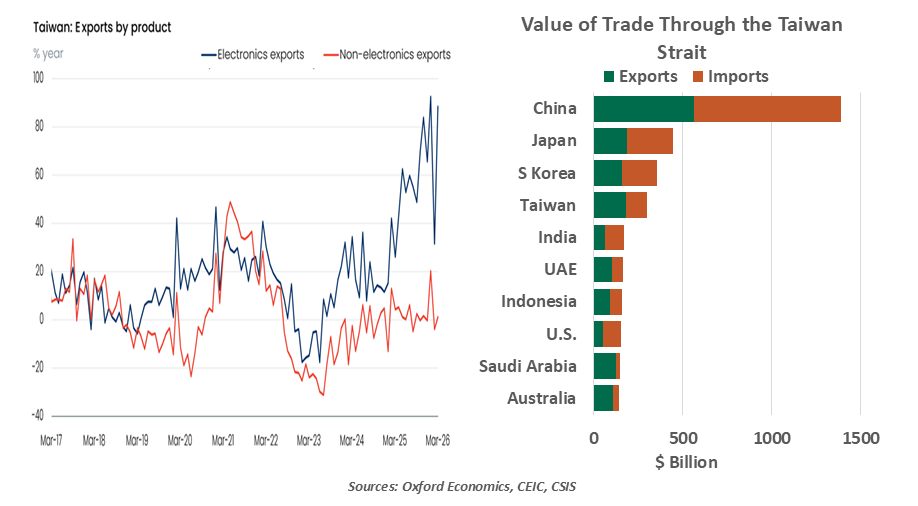
As was clear from this week’s summit meeting with the United States, Beijing would like to see Taiwan reunited with the mainland. One source of pressure toward that end might be a naval blockade; Rhodium Group estimates that such an action, similar to one in the Middle East, could result in global output losses of up to $2 trillion. Costs could climb to as much as $10 trillion (around 10% of global GDP) if the conflict escalates into direct military confrontation in the region, according to Bloomberg analysis. China, Japan, South Korea and Taiwan would likely be among the most affected, given that roughly $1.3 trillion of Chinese trade passes through the waterway.
The “K‑” wave has made its mark in visible ways, from global entertainment to the Korean beauty products my wife swears by. Taiwan shows up differently in our house: not seen, but embedded in the technology we rely on every day. Its prominence is less about visibility and more about vitality. In today’s economic landscape, it may prove to be the more consequential form of influence.
Related Articles
Meet Your Expert
Vaibhav Tandon
Chief International Economist
Vaibhav Tandon is the Chief International Economist within the Global Risk Management division of Northern Trust. In this role, Vaibhav briefs clients and colleagues on the economy and business conditions, supports internal stress testing and capital allocation processes, and publishes the bank’s formal economic viewpoint. He publishes weekly economic commentaries and monthly global outlooks.

Meet Our Team


Subscribe to Publications on Economic Trends & Insights
Gain insight into economic developments and our latest forecasts for the United States.
Information is not intended to be and should not be construed as an offer, solicitation or recommendation with respect to any transaction and should not be treated as legal advice, investment advice or tax advice. Under no circumstances should you rely upon this information as a substitute for obtaining specific legal or tax advice from your own professional legal or tax advisors. Information is subject to change based on market or other conditions and is not intended to influence your investment decisions.
© 2026 Northern Trust Corporation. Head Office: 50 South La Salle Street, Chicago, Illinois 60603 U.S.A. Incorporated with limited liability in the U.S. Products and services provided by subsidiaries of Northern Trust Corporation may vary in different markets and are offered in accordance with local regulation. For legal and regulatory information about individual market offices, visit northerntrust.com/terms-and-conditions.