- Who We Serve
- What We Do
- About Us
- Insights & Research
- Who We Serve
- What We Do
- About Us
- Insights & Research

Weekly Economic Commentary | April 17, 2026
More Supply Chain Stress
Conflict is exposing the fragility of global networks.
By Carl Tannenbaum
I was working in one of our regional offices this week when the network on our floor experienced a brief outage. People were clearly not prepared for a return to an analog world, and grew increasingly anxious as the minutes ticked by.
For the second time in six years, we’re experiencing an interruption within the world’s economic network. The impacts from the war in Iran aren’t yet in the same league as the consequences of COVID-19, but they are producing significant anxiety.
The war has complicated logistics on land, sea, and in the air.
There are several forms of disorientation at play. Firstly, the closure of the Strait of Hormuz has prevented ships from traversing their normal routes. Some are being sent around the Cape of Good Hope, but this adds two weeks and substantial cost to the journey from the Middle East to Europe. The BBC estimates that around 800 fully loaded ships are stuck in the region, awaiting an opportunity to progress. Vessels are out of position, which will challenge logistics far from the fighting.
Secondly, while a primary focus has been on seaborne shipping, air cargo capacity in the Middle East had declined by almost half through the end of March. Airport closures and route limitations have been common, leading shippers to truck products overland to find exit points. This has created particular problems for the pharmaceutical sector, which relies heavily on air freight that travels through Gulf countries.
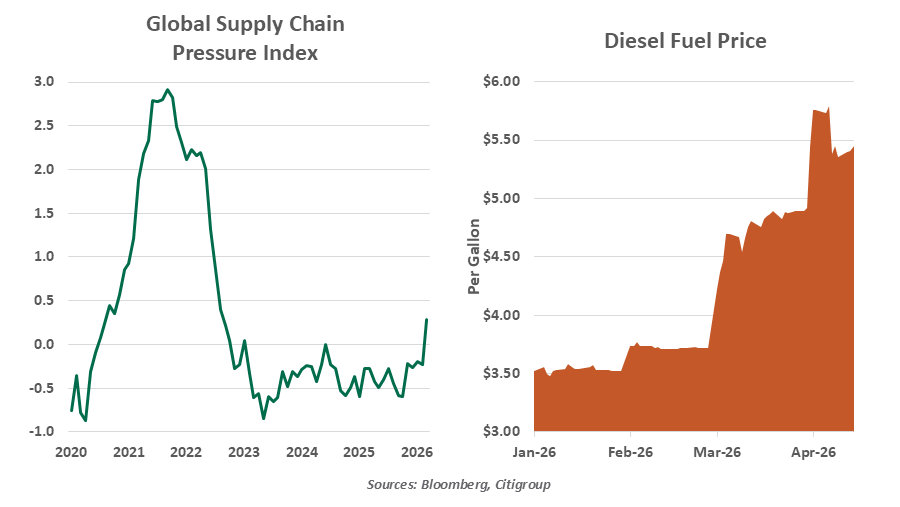
Thirdly, problems at sea and in the air affect land-based shipping. Trucks and rail cars stand waiting at intermodal ports around the world, creating scheduling challenges. If cargo does not arrive promptly, bottlenecks in overland transit can accumulate. And rising prices for diesel fuel are increasing costs for shippers and operators.
During the five-minute outage, partners in my regional office were reminded of how dependent they are on the continuity of a network. The same could be said of the global economy; unfortunately, addressing disruption will require more than a few IT experts.
Related Articles
Meet Your Expert
Carl Tannenbaum
Chief Economist
Carl Tannenbaum is the Chief Economist for Northern Trust. In this role, he briefs clients and colleagues on the economy and business conditions, prepares the bank's official economic outlook and participates in forecast surveys. He is a member of Northern Trust's investment policy committee, its capital committee, and its asset/liability management committee.

Meet Our Team



Subscribe to Publications on Economic Trends & Insights
Gain insight into economic developments and our latest forecasts for the United States.
Information is not intended to be and should not be construed as an offer, solicitation or recommendation with respect to any transaction and should not be treated as legal advice, investment advice or tax advice. Under no circumstances should you rely upon this information as a substitute for obtaining specific legal or tax advice from your own professional legal or tax advisors. Information is subject to change based on market or other conditions and is not intended to influence your investment decisions.
© 2026 Northern Trust Corporation. Head Office: 50 South La Salle Street, Chicago, Illinois 60603 U.S.A. Incorporated with limited liability in the U.S. Products and services provided by subsidiaries of Northern Trust Corporation may vary in different markets and are offered in accordance with local regulation. For legal and regulatory information about individual market offices, visit northerntrust.com/terms-and-conditions.