- Who We Serve
- What We Do
- About Us
- Insights & Research
- Who We Serve
- What We Do
- About Us
- Insights & Research

Weekly Economic Commentary | April 17, 2026
Reduced Energy Intensity Reduces Risk
Growth still requires energy, just less of it over time.
By Ryan Boyle
Every employee has heard calls to be more efficient: “Work smarter, not harder.” “Do more with less.” “Don't reinvent the wheel.” These platitudes are not only applicable at the micro level: the modern economy has continually become more efficient. Our use of energy tells the story clearly, and serves as a source of resilience during today’s supply disruptions.
Energy intensity measures how much energy is needed for economic output. At the national level, intensity is the ratio of a country’s energy consumption to its gross domestic product (GDP). A lower number means the economy is squeezing more value from its kinetic inputs. Though intensities are not uniform across the world, the metric is improving in most markets.
The industrial sector represents the largest share of energy consumption. Economies of usage have advanced steadily, and as they compound upon themselves, gains are greater. Engineers look to efficiency as the “first fuel:” the most valuable input is the energy that isn’t used. Factories have been retrofit with more efficient equipment as their tooling reaches its end of life, while newer facilities use the very latest technology.
Output still depends on energy, but less of it each year.
As examples, waste heat expelled by a production process can be reused to heat other buildings, and water recycled for cooling and plumbing. Most grocery stores have modified their refrigerated cases from an open format to putting products behind doors; the U.S. Environmental Protection Agency estimates a 30% reduction in electricity bills from the conversion. Transportation is also a major user of energy; all vehicles have become more efficient, but the greatest gains have accrued to larger vehicles. Older diesel semi-trailers averaged only five miles per gallon (47 l/100km); recent improvements to just seven miles per gallon (34 l) may save more than a million gallons (3.8m liters) of fuel across the truck's lifespan.
A structural change that has supported lower intensity has been a transition away from production. As services gain a greater share of economic output, intensity has fallen. But that has made industrial production more geographically concentrated, causing an uneven trend of intensity gains. The Maddison Project, an academic effort to research global energy use, estimates that overall energy intensity has fallen by 30% from 2000 to 2022. European nations gained through conservation policies; Middle Eastern nations have made progress, though their extractive industries keep the intensity of those nations relatively high. Of the 169 nations studied, 36 show an increase, particularly in emerging and frontier markets.
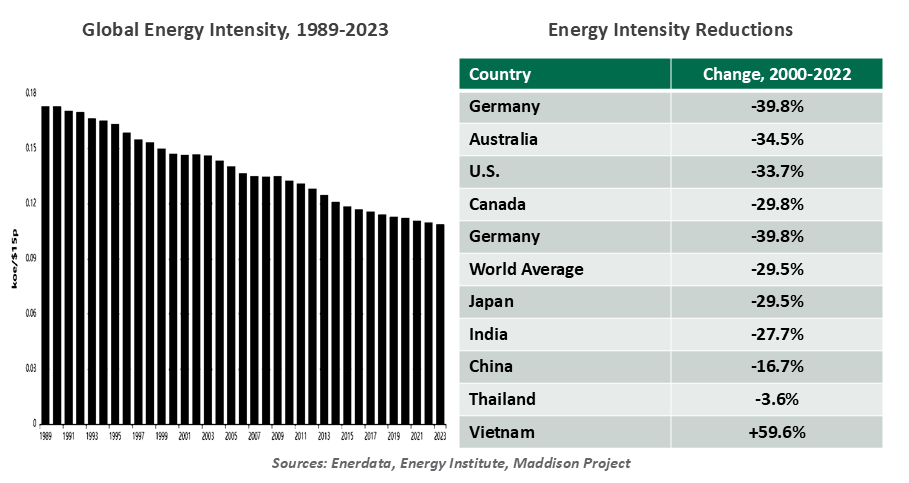
Developing economies will often take an export-led approach to economic growth, requiring lots of power. Conventional power sources like coal are the easiest to deploy rapidly, adding to emissions and intensity. Many African nations showing greater intensity are growing in polluting sectors like mining. And while China leads the world in their speed of clean energy deployment, their intensity remains in the upper half of all nations; maintaining production has taken priority over the green transition.
We highlight improved energy intensity as one reason we don't leap to worst-case conclusions from the current disruption to global energy markets. The oil embargo of the 1970s led to curtailed production and severe recessions. Today, lower intensity helps to blunt the effects of an oil shortfall. But that is not to suggest that the energy shock will be harmless. The global economy is highly interconnected, and supply chains are optimized for efficiency of total cost, not just energy. Goods production remains centered in energy-intensive Asian nations, and risks may rapidly transmit from there.
Managers have long advised that success comes when preparation meets opportunity. Advancements in efficiency were good preparation for this new interval of higher energy costs and reduced supply. But there are certainly opportunities to get even better.
Related Articles
Read Past Articles
Meet Your Expert
Ryan Boyle
Chief U.S. Economist
Ryan James Boyle is the Chief U.S. Economist within the Global Risk Management division of Northern Trust. In this role, Ryan is responsible for briefing clients and partners on the economy and business conditions, supporting internal stress testing and capital allocation processes, and publishing economic commentaries.

Meet Our Team


Subscribe to Publications on Economic Trends & Insights
Gain insight into economic developments and our latest forecasts for the United States.
Information is not intended to be and should not be construed as an offer, solicitation or recommendation with respect to any transaction and should not be treated as legal advice, investment advice or tax advice. Under no circumstances should you rely upon this information as a substitute for obtaining specific legal or tax advice from your own professional legal or tax advisors. Information is subject to change based on market or other conditions and is not intended to influence your investment decisions.
© 2026 Northern Trust Corporation. Head Office: 50 South La Salle Street, Chicago, Illinois 60603 U.S.A. Incorporated with limited liability in the U.S. Products and services provided by subsidiaries of Northern Trust Corporation may vary in different markets and are offered in accordance with local regulation. For legal and regulatory information about individual market offices, visit northerntrust.com/terms-and-conditions.