
Weekly Economic Commentary | November 14, 2025
Closing The Books On U.S. Fiscal 2025
The U.S. deficit narrowed slightly, with tough prospects ahead.
By Ryan Boyle
We have sorely missed the output of the federal statistical agencies that were closed in the shutdown. But one agency did keep publishing: data from the Treasury Department kept on coming, and it wasn’t pretty.
Closing the books on fiscal year 2025, the U.S. ran a deficit of $1.77 trillion, a slight improvement from $1.83 trillion in 2024. But a peacetime deficit exceeding 6% of gross domestic product (GDP) is still cause for worry. Can it improve?
The Department of Government Efficiency (DOGE) was uniquely empowered to halt spending. DOGE claims to have saved $214 billion, though independent analysis gives reason to take that estimate as an upper bound. Discretionary spending should be reviewed carefully, but cuts alone will fall short of balancing the budget.
Policy changes have not altered the fundamental budget imbalance.
Tariffs were the most prominent economic policy of the year. They are in force, and revenues are material. Receipts from customs duties were just shy of $30 billion per month in August and September, five times the prior norm. Revenue in the year ahead may easily exceed $300 billion.
However, entitlement spending and interest expenses are also on the rise, absorbing the higher tariff receipts. Materially shrinking the deficit will be difficult. Tariff flows will rise as inventories are replenished and new sector-level duties are codified. (If partly overturned by the Supreme Court, we do not expect tariffs to go away.) Over 150,000 federal workers accepted the “buyout” offer and departed at fiscal year-end, which will lower payroll expenses. However, an aging population using costly healthcare may absorb any gains from reducing the size of the government.
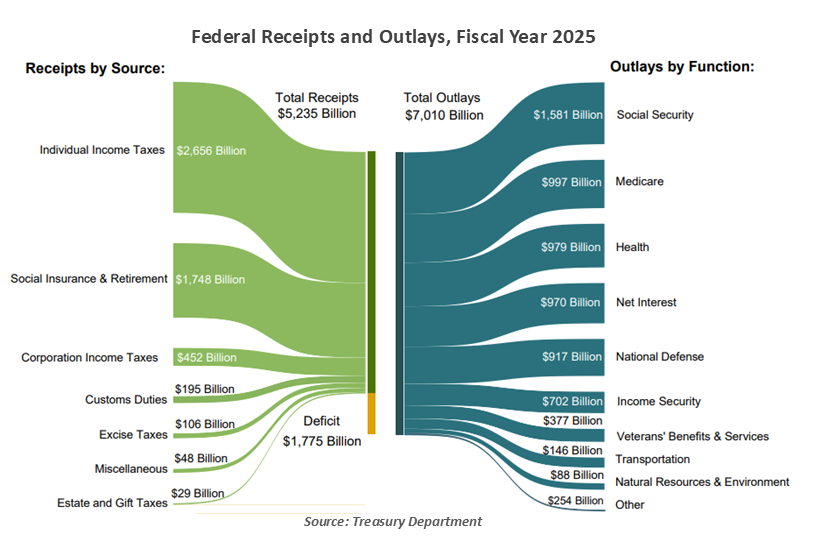
The nation’s long-run outlook remains troubling. Lower tax rates and incentives passed in this summer’s fiscal reconciliation package will limit tax revenue. The Congressional Budget Office (CBO) has not updated its long-term budget outlook since March, but an analysis using the CBO’s methodology forecast a debt to GDP ratio of at least 183% in 2054, from 123% today.
We are glad to see government workers getting back on the job. Now, it would be nice to see Congress get to work on limiting the budget deficit.
Related Articles
Meet Our Team



Subscribe to Publications on Economic Trends & Insights
Gain insight into economic developments and our latest forecasts for the United States.
Information is not intended to be and should not be construed as an offer, solicitation or recommendation with respect to any transaction and should not be treated as legal advice, investment advice or tax advice. Under no circumstances should you rely upon this information as a substitute for obtaining specific legal or tax advice from your own professional legal or tax advisors. Information is subject to change based on market or other conditions and is not intended to influence your investment decisions.
© 2026 Northern Trust Corporation. Head Office: 50 South La Salle Street, Chicago, Illinois 60603 U.S.A. Incorporated with limited liability in the U.S. Products and services provided by subsidiaries of Northern Trust Corporation may vary in different markets and are offered in accordance with local regulation. For legal and regulatory information about individual market offices, visit northerntrust.com/terms-and-conditions.