Weekly Economic Commentary | December 5, 2025
International Power Plays
Some nations will struggle to meet the rising demand for energy.
By Vaibhav Tandon
With great power comes great responsibility. But in the age of artificial intelligence (AI), power means megawatts, not metaphors.
As AI models grow more complex, their hunger for computational power is reshaping energy priorities far beyond American borders. Data centers’ electricity consumption has been surging, thanks to exploding demand for AI. A single 100-megawatt data center can consume as much power as 100,000 households. According to the International Energy Agency, global power use from data centers is estimated to have reached 415 terawatt-hours (TWh) in 2024, more than double the level in 2015. That’s already more than the entire electricity usage of France, and demand is expected to double within five years.
The question is no longer whether demand will rise, it’s how fast, and whether power systems can keep up.
To meet surging electricity demand, nations may have to rethink entire energy systems.
China accounted for roughly a fourth of global data center electricity consumption in 2024, second only to the United States. Yet its dominance in clean energy puts the country on uniquely strong footing in the global AI race. Today, coal still powers over 70% of China’s data centers, but renewables contribute about 20%. While coal remains a near-term crutch, Beijing’s aggressive solar and wind targets position China well for the AI era. Over the next decade, renewables and nuclear are expected to supply about 60% of data center electricity. China’s manufacturing edge, producing 80% of the world’s solar panels and 60% of wind turbines at lower costs than the West, gives it a strategic advantage in pivoting toward clean energy and sustaining AI growth.
The Nordics are better placed than most within Europe, thanks to cheap and abundant power from nuclear, hydro, wind and solar sources. With nearly 100% renewable electricity, a naturally cool climate, and some of the lowest energy prices in Europe, Nordic nations offer a compelling mix of sustainability and scale.
Elsewhere in Europe, the picture is more complex. Climate targets, sustainability mandates and aging grids clash with soaring AI energy demand. In hubs like Dublin and Frankfurt, the process of securing and delivering electrical capacity can stretch up to five years, with equipment delays alone often surpassing three years. Ireland is a cautionary tale: data centers could consume nearly a third of its electricity by 2030. The EU is projected to need over $1 trillion in grid investment this decade to keep pace. Meeting data center demand will be important if Europe is to unleash AI’s full economic potential and enhance productivity growth. The EU’s response thus far has been to introduce caps on data center energy use and to enact strict sustainability mandates.
India faces an even tougher road. India’s ambitious AI goals are set to collide with infrastructure realities. While initiatives like Digital India have connected millions to high-speed internet, frequent outages and sluggish integration of renewable energy could constrain growth. Even tech hubs like Bangalore struggle with daily power cuts.
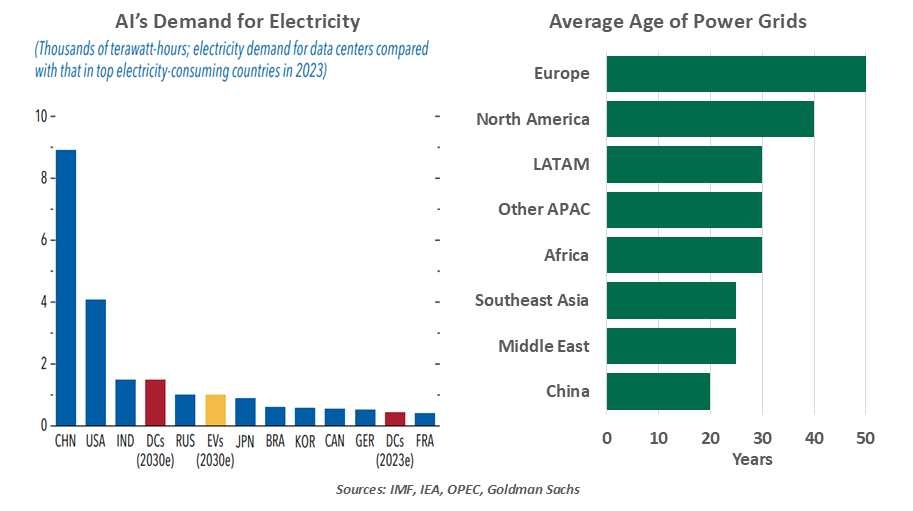
Developing nations will struggle in scaling AI.
Developing economies will face steeper hurdles in the form of financing constraints and weak transmission networks, making scaling AI-ready power a distant goal. In low income countries, only 27% of residents have internet access, compared to over 90% in high-income nations. Without further investments in power generation and grid infrastructure, supporting AI expansion would mean redirecting electricity from other economic activities, creating significant challenges for energy-intensive sectors and broader growth.
AI’s promise comes with a power price tag. Nations with abundant energy, modernized grids and coherent policy will be favored. Those without will face slower adoption, higher costs and tougher trade-offs. In the AI race, megawatts will matter as much as models.
Related Articles
Meet Our Team



Subscribe to Publications on Economic Trends & Insights
Gain insight into economic developments and our latest forecasts for the United States.
Information is not intended to be and should not be construed as an offer, solicitation or recommendation with respect to any transaction and should not be treated as legal advice, investment advice or tax advice. Under no circumstances should you rely upon this information as a substitute for obtaining specific legal or tax advice from your own professional legal or tax advisors. Information is subject to change based on market or other conditions and is not intended to influence your investment decisions.
© 2026 Northern Trust Corporation. Head Office: 50 South La Salle Street, Chicago, Illinois 60603 U.S.A. Incorporated with limited liability in the U.S. Products and services provided by subsidiaries of Northern Trust Corporation may vary in different markets and are offered in accordance with local regulation. For legal and regulatory information about individual market offices, visit northerntrust.com/terms-and-conditions.