
Weekly Economic Commentary | June 18, 2026
AI Downsides Dominate Discourse
Skepticism of AI may keep its growth in check.
By Ryan Boyle
At graduation ceremonies, audiences are often reminded to limit their audible reactions and hold applause, so that all graduates’ names can be heard. But a few viral videos this year showed a new disturbance to be managed: graduating students booing speakers if they extolled the virtues of artificial intelligence (AI).
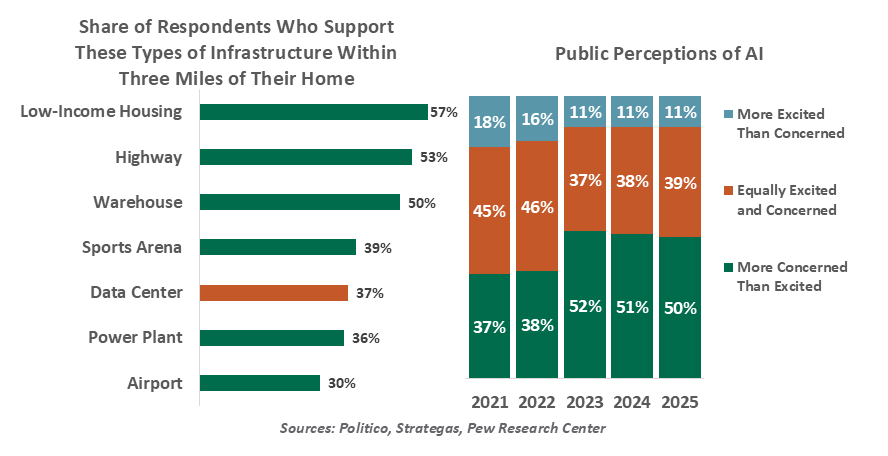
This year has been marked by a shift in the perceptions of AI. The technology gained mainstream attention upon the public launch of ChatGPT in November 2022. For a few years thereafter, users explored the new capabilities, businesses set adoption strategies, and investors rewarded any firm with exposure to AI. But in the year to date, markets have grown nervous, security experts are on alert, communities are protesting, and students are rebelling.
New entrants to the labor force may see AI as competition, with good cause. Harvard University economists found a pronounced decline in junior-level job postings by firms who adopted AI, and for positions more exposed to AI. The trend emerged conspicuously in 2023 as ChatGPT took root.
Macro risks around AI are on the rise. Anthropic found that its latest model, Mythos 5, could identify software security vulnerabilities with a speed and precision that far exceeded any human hacker. The model was previewed for only select institutions for research into its security. Last week, the company launched a scaled-back version, Fable 5, but it, too, was taken offline on orders from the U.S. government when it showed potential as a cyber weapon. Other AI firms are sure to launch models that can be used similarly; defending against them will be a tall order. A large-scale cyberattack could quickly undo any economic upside that AI adoption had promised.
Ethical worries are also mounting: AI-generated content lends itself to plagiarism, and AI-manipulated images have broken boundaries of consent and decency. Copyright and privacy laws were not designed to protect against the vast, indiscriminate data-gathering of AI models.
Citizens are organizing to protest new data centers, citing worries about noise, water and electricity consumption, along with limited economic benefit to communities that host these structures. Some of the sentiment may stem from seeing data centers as the embodiment of AI. Demand for AI capacity is rising, but data center limitations could become a barrier to growth.
Public pushback on AI may limit its potential.
Market enthusiasm has also found limits this year. Private credit lenders with software exposures have seen higher redemptions; publicly-traded funds have been challenged. AI dominance will require tremendous capital outlays, which is crowding out investment in other sectors.
The makers of AI models are not ignoring their disruptive potential. OpenAI and Anthropic have published policy frameworks to help governments deal with the potential economic fallout of an AI transition, especially lower employment. Their proposals include more funding for job retraining, more income relief programs, and investment in AI safety and education.
Current policy responses focus on immediate risks. President Trump signed an executive order (EO) for federal cybersecurity coordination and to encourage AI developers to share new models to evaluate their security. The EO makes participation voluntary, a change from a leaked draft that mandated pre-clearance. And as of April, 222 local governments—across red and blue regions—passed laws to pause data center construction. Fourteen statewide moratoria have been proposed.
One of the best commencement speeches was delivered by a technology visionary: Steve Jobs, at Stanford in 2005. In it, he reflected on his journey of embracing uncertainty: dropping out of college, getting fired, facing a health scare. The rise of AI is creating uncertainty for today’s students, and they are expressing their frustration. Hopefully, Jobs’ message that good things can emerge from challenging times will ring true for the class of 2026.
Related Articles
Meet Your Expert
Ryan Boyle
Chief U.S. Economist
Ryan James Boyle is the Chief U.S. Economist within the Global Risk Management division of Northern Trust. In this role, Ryan is responsible for briefing clients and partners on the economy and business conditions, supporting internal stress testing and capital allocation processes, and publishing economic commentaries.
Meet Our Team

Subscribe to Publications on Economic Trends & Insights
Gain insight into economic developments and our latest forecasts for the United States.
Information is not intended to be and should not be construed as an offer, solicitation or recommendation with respect to any transaction and should not be treated as legal advice, investment advice or tax advice. Under no circumstances should you rely upon this information as a substitute for obtaining specific legal or tax advice from your own professional legal or tax advisors. Information is subject to change based on market or other conditions and is not intended to influence your investment decisions.
© 2026 Northern Trust Corporation. Head Office: 50 South La Salle Street, Chicago, Illinois 60603 U.S.A. Incorporated with limited liability in the U.S. Products and services provided by subsidiaries of Northern Trust Corporation may vary in different markets and are offered in accordance with local regulation. For legal and regulatory information about individual market offices, visit northerntrust.com/terms-and-conditions.