
Weekly Economic Commentary | April 10, 2026
Helium Is Elementary
A light element has a heavy industrial need.
By Vaibhav Tandon
Science fiction writer Harlan Ellison once quipped that hydrogen and stupidity are the two most common elements in the universe. While poor judgment may indeed be plentiful, it is helium that ranks as the second most common element after hydrogen. And yet, owing to human folly, even this seemingly abundant element is becoming increasingly scarce on Earth.
Beyond keeping party balloons aloft, helium plays a far more serious role in the modern economy. Extracted as a by‑product of natural gas production, it is an essential input across semiconductors, medical imaging, aerospace and defense systems.
Underground deposits of helium are geographically concentrated, and the lightweight gas is easily lost to the atmosphere. Qatar produces roughly 63 million cubic meters of helium annually, accounting for about one‑third of global supply. Recent attacks on Qatar’s energy infrastructure have disrupted its gas output. This has, in turn, curtailed helium production. The supply chain’s fragility has been laid bare.
Helium is the subject of yet another war-related supply disruption.
The impact is likely to be felt most acutely in Asia. South Korea, Japan, Taiwan and China are among the largest consumers of Qatari helium and also top producers of advanced tech equipment. South Korea, which sourced roughly two‑thirds of its helium from Qatar last year, warned that a prolonged supply crunch would weigh on semiconductor production. Taiwan faces similar exposure given its reliance on imported helium for chip manufacturing.
Even if the current ceasefire holds, some of the lost supply will not be easily reversed. Repairs in Qatar are expected to take years rather than months. This raises the risk that sustained shortages could slow technological advancement or constrain the pace of the artificial intelligence build‑out.
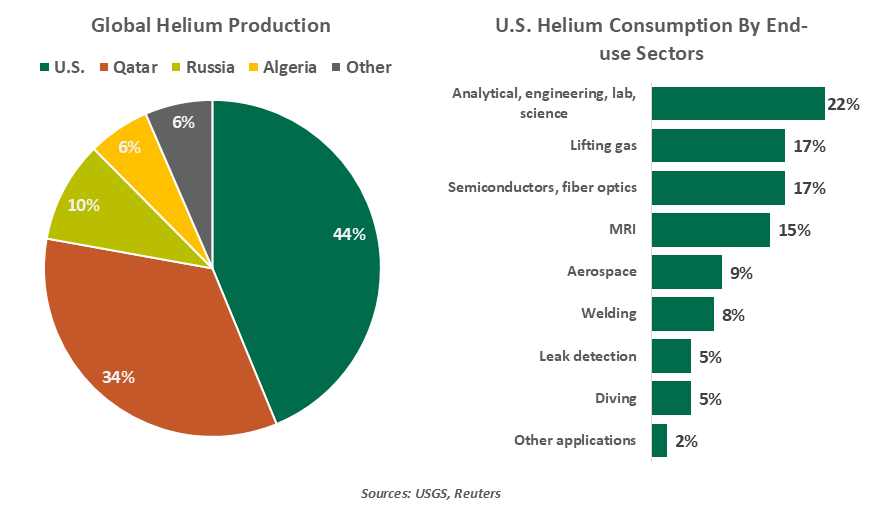
That near‑term risk is partly mitigated by inventories held by chipmakers, along with shipments that were already en route when hostilities escalated. The United States – the world’s largest helium producer, accounting for over 40% of global supplies – can help fill part of this gap, too.
Even so, the episode underscores a familiar lesson. Scarcity is less about what exists in nature and more about how efficiently it is managed. In that sense, Ellison’s observation still holds: hydrogen may be abundant, but human miscalculation can turn abundance into constraint.
Related Articles
Meet Your Expert
Vaibhav Tandon
Chief International Economist
Vaibhav Tandon is the Chief International Economist within the Global Risk Management division of Northern Trust. In this role, Vaibhav briefs clients and colleagues on the economy and business conditions, supports internal stress testing and capital allocation processes, and publishes the bank’s formal economic viewpoint. He publishes weekly economic commentaries and monthly global outlooks.

Meet Our Team


Subscribe to Publications on Economic Trends & Insights
Gain insight into economic developments and our latest forecasts for the United States.
Information is not intended to be and should not be construed as an offer, solicitation or recommendation with respect to any transaction and should not be treated as legal advice, investment advice or tax advice. Under no circumstances should you rely upon this information as a substitute for obtaining specific legal or tax advice from your own professional legal or tax advisors. Information is subject to change based on market or other conditions and is not intended to influence your investment decisions.
© 2026 Northern Trust Corporation. Head Office: 50 South La Salle Street, Chicago, Illinois 60603 U.S.A. Incorporated with limited liability in the U.S. Products and services provided by subsidiaries of Northern Trust Corporation may vary in different markets and are offered in accordance with local regulation. For legal and regulatory information about individual market offices, visit northerntrust.com/terms-and-conditions.