
Weekly Economic Commentary | January 30, 2026
Japan's Budget Busting
Bonds are pricing in a new outlook for Japan.
By Vaibhav Tandon
Japan’s bustling cities and serene landscapes have long made it a dream destination for visitors. But beneath the surface, Japan’s economic landscape is undergoing a reordering that is now drawing the attention of investors as much as tourists.
With interest rates stuck near zero, Japanese government bonds have served as a reliable source of cheap funding and stability for global investors for more than two decades. But the safe haven is breaking down. Volatility in Japan’s once-dormant debt market has climbed over the past two years, with the yield on 10-year Japanese government bonds (JGB) more than doubling to 2.25%. The Bank of Japan’s decision to abandon yield curve control has been central to the shift. By mid‑2024, the pressure became clear as investors rushed to unwind over one trillion dollars in yen‑funded positions, dragging both global equities and bonds lower. These dramatic shifts have altered the historic perception of the yen as a stable, safe-haven currency.
Last week, bond markets experienced an unprecedented selloff, with the 40‑year bond yield surging past 4% for the first time in history. Coupled with dramatic swings in the yen, it underscored that the era of low volatility is over. Prime Minister Takaichi’s decision to suspend sales taxes on food after the February snap election, combined with a sizeable supplementary budget, has fueled concerns about a tilt toward a looser fiscal stance. With inflation already embedded, her agenda risks both stoking price pressures further and expanding an already massive public debt burden. This, in turn, could force the Bank of Japan to act more forcefully. Higher lending rates would strain small businesses and households that are already contending with rising costs and labor shortages.
This is not a “Liz Truss moment” for Japan.
Although bond prices have recovered modestly, the risk of renewed turbulence remains elevated. Japan’s government is deeply indebted, with a debt to gross domestic product (GDP) ratio of over 200% — the highest among major advanced economies. This structural vulnerability helps explain why ultra long-term yields jumped more than 25 basis points in a single day following the policy announcement. According to Bloomberg, last week’s plunge in ultra-long bonds wiped out an estimated $41 billion in value across the curve.
Despite market jitters, a crisis is not imminent. Japan’s public debt-to-GDP ratio has been gradually declining for four years, underpinned by strong nominal GDP growth. The fiscal deficit has narrowed and stands favorably with peers. The government’s interest burden remains manageable at 1.5% of GDP, less than half the level in the United States.
Still, higher yields and renewed currency volatility will ripple across global financial markets. Ultra-low interest rates and scant volatility made the yen the world’s preferred currency for the carry trade: borrowing cheaply in yen and investing in higher yielding assets abroad. As JGB yields rise and spreads with major markets narrow, domestic investors may begin repatriating funds. Some large institutions are already taking a more favorable view of their home market.
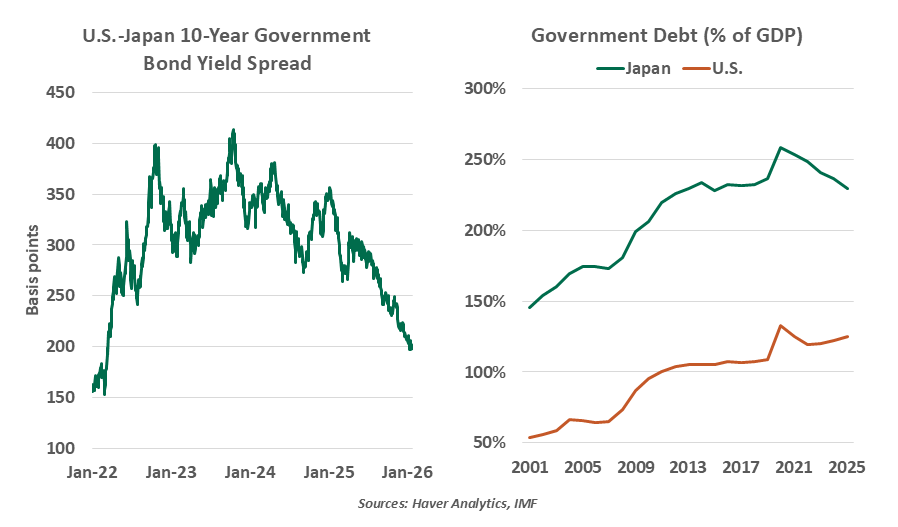
Given Japan’s status as the largest foreign holder of U.S. Treasuries and agency mortgage-backed securities, even a modest shift could put upward pressure on U.S. yields. About $5 trillion of the country's capital is deployed overseas. Risk‑parity funds, which are structured to equalize volatility across asset classes, may need to reduce exposure by roughly one‑third. This move could trigger up to $130 billion in U.S. bond sales.
While international tourists have been drawn by the country’s newfound affordability, domestic investors may also begin recalibrating their assumptions about their own market. Japan’s transformation is reshaping travel itineraries and investment strategies alike, and the journey may have only just begun.
Related Articles
Meet Our Team



Subscribe to Publications on Economic Trends & Insights
Gain insight into economic developments and our latest forecasts for the United States.
Information is not intended to be and should not be construed as an offer, solicitation or recommendation with respect to any transaction and should not be treated as legal advice, investment advice or tax advice. Under no circumstances should you rely upon this information as a substitute for obtaining specific legal or tax advice from your own professional legal or tax advisors. Information is subject to change based on market or other conditions and is not intended to influence your investment decisions.
© 2026 Northern Trust Corporation. Head Office: 50 South La Salle Street, Chicago, Illinois 60603 U.S.A. Incorporated with limited liability in the U.S. Products and services provided by subsidiaries of Northern Trust Corporation may vary in different markets and are offered in accordance with local regulation. For legal and regulatory information about individual market offices, visit northerntrust.com/terms-and-conditions.