
Weekly Economic Commentary | April 2, 2026
Middle Powers In A Fragmented World
The world's second-tier economies are moving to the forefront.
Editor’s note: we’re publishing an abbreviated edition this week, in advance of the holiday weekend.
By Vaibhav Tandon
The middle is typically not where you want to be. In American sports, teams in the middle of the standings aren’t contenders for either a championship or a high draft choice. The middle seat on an airplane, subject to incursions from either side, is not very comfortable. The middle manager is accountable in every direction, empowered in none.
In the same spirit, it is of little surprise that governments labeled “middle powers” often resist the term, uneasy about what it signals about their status in the world. But in the past year, the middle powers have been moving to the forefront.
The designation “middle power” traces back to World War II-era debates over the role of countries like Canada and Australia in shaping the postwar order. The phrase returned to the spotlight recently after Canada’s prime minister used his January address to the World Economic Forum to argue that middle powers “are not powerless,” and should coordinate more actively as the world’s major powers go their separate ways.
Middle powers will become more influential in the years ahead.
There is no universally accepted definition of a middle power, other than they occupy the tier below the dominant economies of the world. There is consensus in the current day that the roster of middle powers includes Canada, Australia, South Korea, India, Brazil, Mexico, Spain, Sweden, Türkiye, Saudi Arabia and the United Arab Emirates. They account for roughly a little over one‑fifth of the world’s economic output. Many are deeply embedded in global value chains, serving as critical hubs for commodities, manufacturing, and logistics.
Broadly, these nations carry meaningful influence through economic size, trade integration, military capacity and participation in multilateral institutions. Many have the ambition and resources to punch above their weights.
That ambition has become more important in a world where America has become more protective and China remains reluctant to meaningfully open its economy to imports. In this environment, middle powers can serve as the incremental engines of global trade, both as markets and as partners for one another. This shift is already evident in Canada’s efforts to diversify exports toward Europe and India, as well as in Europe’s growing push for trade diversification through agreements with partners such as India and Latin America.
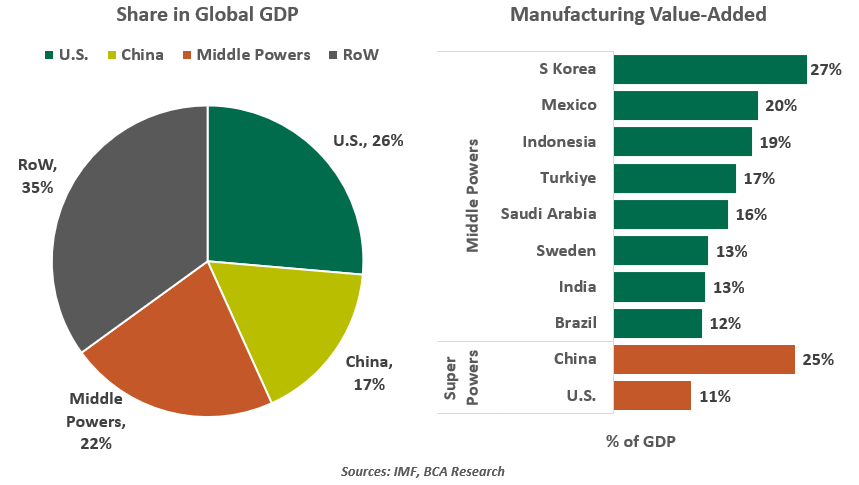
The scale of demand among middle powers is not trivial. The combined household consumption of middle powers rivals China’s, and can serve as a partial offset if access to the American consumer market is hindered by tariffs.
Demographics and capital accumulation further strengthen the position of middle powers. Large populations in countries like India are potential sources of demand, while expanding pools of capital from middle powers provide financial reach in an increasingly fragmented global economy. The Gulf states, for example, have long invested their oil‑driven trade surpluses overseas in countries like the U.S., giving them financial influence.
Cooperation among middle powers is deepening across a broader set of shared objectives, including climate change, public health, technological innovation, energy security and economic development.
That said, the limits of the category are equally important to acknowledge. Middle powers are not uniformly stabilizing forces, nor are their interests easily aligned. India’s scale supports strong long‑term growth, but familiar middle‑income challenges remain. Several resource‑exporting middle powers retain financial heft but remain exposed to commodity cycles. Some in this category operate under persistent geopolitical pressure, shaping priorities toward security rather than broader global leadership. Others, like Türkiye, have been conduits for volatility rather than stability.
In a more fragmented global economy, middle powers have an opportunity to assume a larger role. They may be modest in size, but they are top of mind.
Related Articles
Meet Your Expert
Vaibhav Tandon
Chief International Economist
Vaibhav Tandon is the Chief International Economist within the Global Risk Management division of Northern Trust. In this role, Vaibhav briefs clients and colleagues on the economy and business conditions, supports internal stress testing and capital allocation processes, and publishes the bank’s formal economic viewpoint. He publishes weekly economic commentaries and monthly global outlooks.
Meet Our Team

Subscribe to Publications on Economic Trends & Insights
Gain insight into economic developments and our latest forecasts for the United States.
Information is not intended to be and should not be construed as an offer, solicitation or recommendation with respect to any transaction and should not be treated as legal advice, investment advice or tax advice. Under no circumstances should you rely upon this information as a substitute for obtaining specific legal or tax advice from your own professional legal or tax advisors. Information is subject to change based on market or other conditions and is not intended to influence your investment decisions.
© 2026 Northern Trust Corporation. Head Office: 50 South La Salle Street, Chicago, Illinois 60603 U.S.A. Incorporated with limited liability in the U.S. Products and services provided by subsidiaries of Northern Trust Corporation may vary in different markets and are offered in accordance with local regulation. For legal and regulatory information about individual market offices, visit northerntrust.com/terms-and-conditions.