
Weekly Economic Commentary | January 23, 2026
New Tracks For Tariffs
New tariffs are still on the horizon this year.
By Ryan Boyle
One of our hopes for 2026 was for a steadier and more cohesive U.S. trade agenda. U.S. objectives had become clearer, and policies would align around them. But cohesion does not mean reduction. New tariffs are still in the pipeline.
A consistent goal of the Trump administration has been to protect sectors of strategic importance for national security. Section 232 of the Trade Protection Act of 1962 authorizes the Secretary of Commerce to investigate the effects of specific imports on national security. The Secretary must report findings to the President, who may impose tariffs or begin negotiations to address the report’s findings. Congress plays no role.
The Section 232 process is slow, but its findings are durable. Investigations may take up to 270 days, and once complete, the President may then act on the report’s recommendations within 90 days. This timeline did not suit the Trump administration’s desire for rapid policy action last year. However, tariffs that result from a 232 investigation are well-defended and likely to stay in place.
For its first 50 years, Section 232 was arcane. The U.S. found only nine national security risks, confined to the petroleum and machine tool sectors. In the first Trump term, the U.S. undertook seven investigations; the most noteworthy outcome was the 25% tariff on steel and aluminum, which remains in force and has since been escalated. The automotive investigation from the first Trump term was dusted off to justify the 25% tariff that went into effect in March 2025.
Section 232 tariffs are well justified and could be permanent.
In the past year, the U.S. has begun new investigations into sectors including pharmaceuticals, rare earths, aircraft, drones and robotics. Results are now coming in, starting last week with reports on semiconductors and critical minerals.
While the reports did find plausible security risks, the outcomes were not extreme. New 25% tariffs will be placed on a small set of advanced semiconductors. The list of exemptions was long, allowing free imports of chips bound for data centers, research, startups and the public sector. The new tariff does not apply to finished products that use these chips, like laptops and smartphones.
Meanwhile, the minerals investigation yielded no new tariffs at this time, but a commitment to negotiate to address U.S. access to rare earths. Existing tariffs, like the Section 301 matter specific to China, remain in force.
The restraint evident in these outcomes reflects the administration’s priorities. Higher costs on consumer goods would exacerbate consumer concerns about affordability. Tariffs on industrial inputs would complicate the reshoring effort.
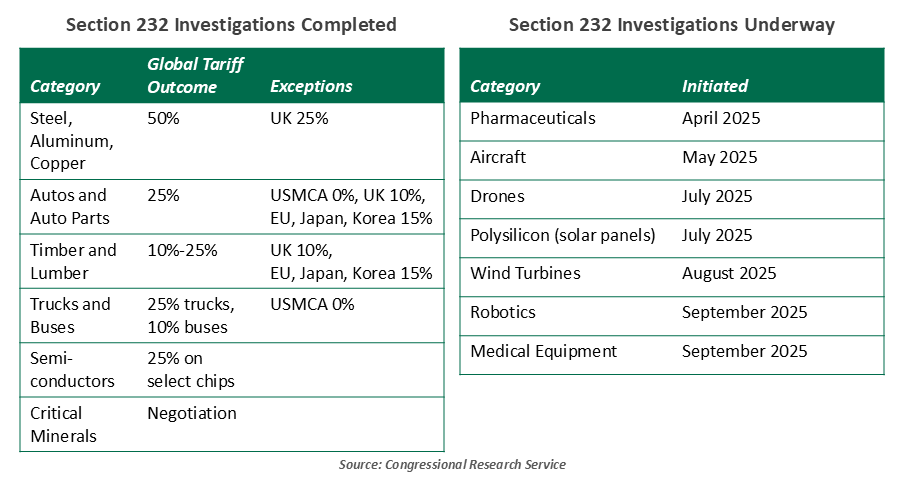
Supporting the semiconductor industry is a point of bipartisan support. The CHIPS Act provided targeted stimulus to rebuild domestic capacity to manufacture semiconductors. The Biden administration also increased export restrictions on intellectual property. The Trump administration has kept those policies in place and added this new protection to further support domestic producers. Tariffs can be a component of industrial policy, but they are just one of many tools.
We will hear more about Section 232 investigations in the year ahead. A pending Supreme Court decision may overturn the use of an emergency declaration to enact tariffs, the primary mechanism employed over the past year. Section 232 tariffs are outside the scope of that challenge. Any Section 232 tariff announced this year is likely to stay in force indefinitely.
This week’s threats of trade restrictions related to Greenland demonstrate that tariffs remain a central instrument of the Trump administration. Some may be bargaining tactics, and some may be negotiated away. But the new spate of Section 232 actions shows that some tariffs are here to stay.
Related Articles
Meet Our Team



Subscribe to Publications on Economic Trends & Insights
Gain insight into economic developments and our latest forecasts for the United States.
Information is not intended to be and should not be construed as an offer, solicitation or recommendation with respect to any transaction and should not be treated as legal advice, investment advice or tax advice. Under no circumstances should you rely upon this information as a substitute for obtaining specific legal or tax advice from your own professional legal or tax advisors. Information is subject to change based on market or other conditions and is not intended to influence your investment decisions.
© 2026 Northern Trust Corporation. Head Office: 50 South La Salle Street, Chicago, Illinois 60603 U.S.A. Incorporated with limited liability in the U.S. Products and services provided by subsidiaries of Northern Trust Corporation may vary in different markets and are offered in accordance with local regulation. For legal and regulatory information about individual market offices, visit northerntrust.com/terms-and-conditions.