
Weekly Economic Commentary | June 12, 2026
Reflections From Asia
A travelogue from a region poised for continued growth.
By Carl Tannenbaum
My first visit to the Northern Trust office in Beijing occurred thirteen years ago. The air quality was so poor that I could scarcely see anything through the window of my hotel room. Walking the streets, I was often the only one not wearing a mask.
I am happy to report that the air in Beijing is much clearer today. The conversations I had there, and in three other Asian capitals last month, brought some useful clarity to the economic outlook for the region…and beyond. Following are the central observations I came home with.
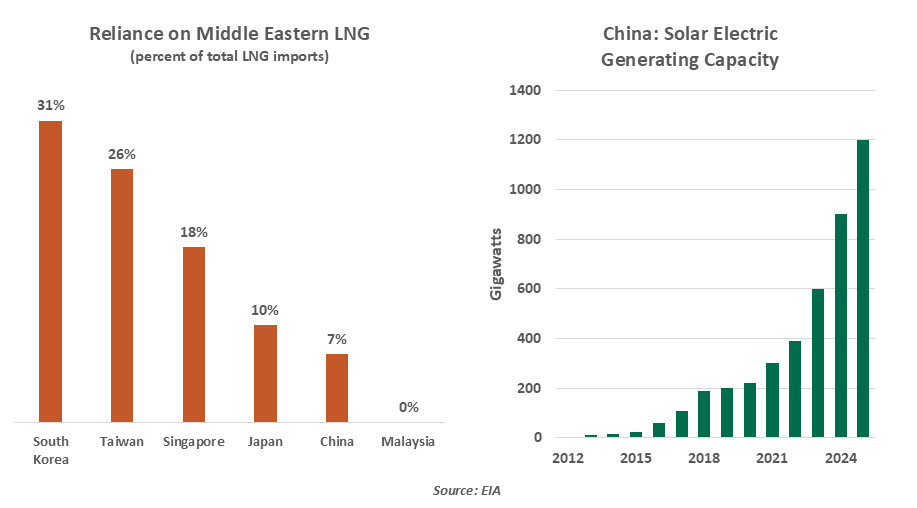
1. The war is having a very modest impact on Asia. China’s oil imports are down more than 3 million barrels per day, but it maintains the largest petroleum reserve in the world (estimated at more than 1 billion barrels of oil). In recent years, the government has steered domestic travelers from air to rail, where high-speed trains run on electricity.
China’s embrace of alternative energy sources is striking: solar panels have been deployed extensively, and electric vehicles dominate. (There is one downside to that: the scooters that compete for rights of way with cars, bicycles and pedestrians are mostly silent now, making it more dangerous to cross the street.) As one analyst observed: China is betting on electrons, while the U.S. is betting on molecules.
China has a strong hand in trade negotiations.
Elsewhere in the region, Malaysia has significant reserves of crude and natural gas, as well as deep refining capacity. Export-driven economies like Japan and Singapore are most challenged by high fuel prices and the shipping dislocations caused by the war; central banks in both countries have had to tighten monetary policy to deal with increased inflation. But neither is at risk of recession. The Philippines is the only country in the area experiencing significant hardship.
There has been concern that shortages of liquified natural gas and helium (which is essential for high-tech manufacturing) from the Middle East would hinder microchip fabrication facilities in South Korea and Taiwan. Both countries came into the war with substantial stockpiles, and both have hurriedly made alternative arrangements with North American suppliers. Recycling of helium is also assisting; interruptions in output appear, for now, to be unlikely.
2. China is exceptionally well-prepared for the next battle in the trade war with the United States. Earlier this month, Washington announced a new round of tariffs. This will be the first in a series of new levies that are based on Section 301 of the Trade Act of 1974. The Act grants the U.S. government the authority to investigate and impose trade sanctions on foreign countries that engage in "unfair" policies or practices. Tariffs established on this basis will be more likely to withstand legal challenge.
Import duties on Asian nations will near the levels that prevailed prior to court decisions striking down the tariffs which were implemented last year. Levies on Chinese exports to the U.S. could reach 30%; Japan and South Korea would be facing levels of about 10%.
For now, China has held its fire, awaiting the conclusions of all section 301 investigations. But Beijing is unlikely to sit still for long. It has demonstrated an ability to respond effectively and comprehensively. Limitations on rare earth exports are even more of a trump card now, given America’s need to replenish its arsenal. Presidents Xi and Trump are scheduled to meet again in September, two months prior to the expiration of their most recent trade truce.
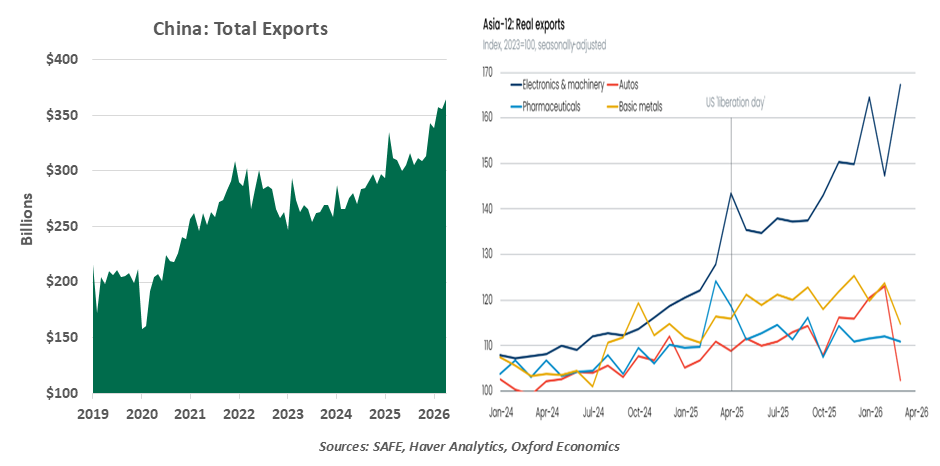
I was in Asia during a busy interval for Chinese diplomacy. Five world leaders visited Beijing in May, which was taken locally as a sign of China’s increasing economic and diplomatic influence. Tariffs and other restrictions have reduced Chinese exports to the U.S., but sales to other countries have more than compensated. Chinese exports continue to set new records.
3. Asia is benefitting significantly from the AI boom. The United States is investing the most, and American developers are making the most significant advances. But a range of Asian countries are along for the ride.
The benefits go beyond the outsized equity returns enjoyed by the region’s big chipmakers, Taiwan and South Korea. (As of this writing, Taiwan’s main equity index is 90% higher than it was a year ago, and South Korea’s is more than 160% higher.) Several countries in the region are significant suppliers of electronic equipment for the world’s data centers. Volumes have jumped, and pricing power is very strong.
These flows have more than offset moderation in other categories, which have been much harder hit by U.S. tariffs. Given the importance of AI-related spending to American economic growth, electronic imports stand a good chance of being favored in upcoming trade negotiations.
Beyond microchips, Asia is a major producer of the equipment that supports AI.
Each visit to Asia reminds me that there is a vibrant economic network there that operates fairly independently. There is an acknowledgement, however, that American demand is still critical to global growth. Asian consumers are savers by nature, and recent supply chain disruptions have reinforced this posture. I got a lot of questions during the trip about the health of U.S. households and the “K-shaped” nature of spending growth. The new Fed Chairman was another topic of interest, as was the American political scene.
Discussions in the region helped to clarify quite a few things for me, and I hope the commentary that I offered to our clients there did the same. While smog is no longer a major issue, there are still plenty of clouds that make it difficult to see the horizon.
Related Articles
Meet Your Expert
Carl Tannenbaum
Chief Economist
Carl Tannenbaum is the Chief Economist for Northern Trust. In this role, he briefs clients and colleagues on the economy and business conditions, prepares the bank's official economic outlook and participates in forecast surveys. He is a member of Northern Trust's investment policy committee, its capital committee, and its asset/liability management committee.

Meet Our Team



Subscribe to Publications on Economic Trends & Insights
Gain insight into economic developments and our latest forecasts for the United States.
Information is not intended to be and should not be construed as an offer, solicitation or recommendation with respect to any transaction and should not be treated as legal advice, investment advice or tax advice. Under no circumstances should you rely upon this information as a substitute for obtaining specific legal or tax advice from your own professional legal or tax advisors. Information is subject to change based on market or other conditions and is not intended to influence your investment decisions.
© 2026 Northern Trust Corporation. Head Office: 50 South La Salle Street, Chicago, Illinois 60603 U.S.A. Incorporated with limited liability in the U.S. Products and services provided by subsidiaries of Northern Trust Corporation may vary in different markets and are offered in accordance with local regulation. For legal and regulatory information about individual market offices, visit northerntrust.com/terms-and-conditions.