
Weekly Economic Commentary | May 8, 2026
Resolving The Trade Emergency
Hedging our expectations about a tariff refund windfall.
By Ryan Boyle
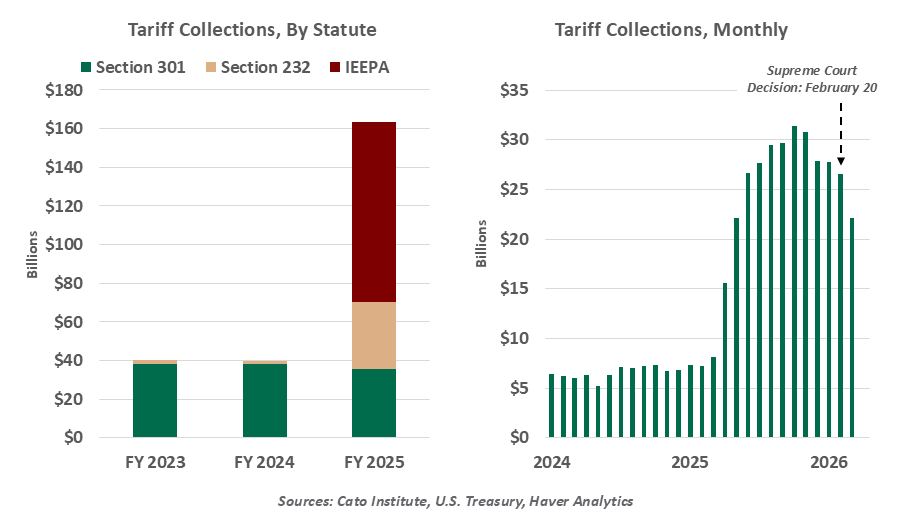
On February 20, the Supreme Court affirmed that tariffs are beyond the scope of the International Emergency Economic Powers Act (IEEPA). IEEPA had been the basis for the majority of trade sanctions in the second Trump term.
The Court’s ruling did not offer direction about how to manage the funds that had been paid. Rather than await further litigation, U.S. Customs and Border Protection agency has launched a new portal for payors to request refunds.
A tariff is a tax on the value of an imported good, paid by the importer at the time the good is taken from an entry port. The tariff is absorbed in some combination of price concessions by the exporter, lower margins for the importer or higher final prices.
As tariffs ratcheted up, forecasters feared a renewed round of inflation on goods. Tariff price adjustments did appear anecdotally, but pass-through was incomplete. The bulk of these costs appear to have been borne by importers and elsewhere along the wholesale value chain. Now, some of those participants will see some relief.
Any relief from tariffs refunds will be short-lived.
The exercise of issuing refunds may sound straightforward, but a full recovery will be a complicated effort. The government estimates that 300,000 importers received over 53 million shipments subject to IEEPA tariffs, totaling $166 billion. Roughly ten months after the transaction, payments are “liquidated” (finalized) and more administratively difficult to unwind. Any relief will be short-lived and is unlikely to flow to households.
A tariff payment record includes only the name of the importer who took receipt of the goods. Major industrial firms and very large retail chains may import directly. More often, goods are received by specialist import dealers who supply intermediate goods to domestic producers or wholesale finished goods to consumer-facing retailers. These importing agents may have passed along their tariff costs in their pricing. As the importers of record, they can now request a tariff reimbursement. But anyone further down the line who paid a higher price is not entitled to any relief.
Retailers hoping to see lower prices may encounter further disappointment. The revocation of IEEPA tariffs is only a brief respite in a relentless trade agenda. Currently, temporary tariffs of 10% under Section 122 are in place. Today’s refund exercise could be repeated the future, as this use of Section 122 is moving down the same path of legal challenges that led to IEEPA’s rejection.
New Section 301 investigations regarding excess capacity and illegal production practices in 16 regions commenced in March; they may be completed in time to justify new tariffs as the interim levies expire in the summer. Several product-level national security investigations under Section 232 are also open. Tariffs are here to stay, even though their legal justifications will evolve. Importers will hold prices firm as they anticipate new tariff announcements.
National finances are also in for a modest shock. The government has been counting on tariff revenue to partially offset lower corporate and income taxes. A loss of $166 billion in tariff proceeds is a strain, but it will not alter the nation’s difficult fiscal trajectory. In the first half of fiscal year 2026, customs duties accounted for 6.7% of all federal tax receipts, up from an old norm of under 2%.
The emergency rationale for tariffs has been overturned. But the announcements, collections, refunding and replacement policies all leave goods markets feeling far from a settled state.
Related Articles
Meet Your Expert
Ryan Boyle
Chief U.S. Economist
Ryan James Boyle is the Chief U.S. Economist within the Global Risk Management division of Northern Trust. In this role, Ryan is responsible for briefing clients and partners on the economy and business conditions, supporting internal stress testing and capital allocation processes, and publishing economic commentaries.

Meet Our Team


Subscribe to Publications on Economic Trends & Insights
Gain insight into economic developments and our latest forecasts for the United States.
Information is not intended to be and should not be construed as an offer, solicitation or recommendation with respect to any transaction and should not be treated as legal advice, investment advice or tax advice. Under no circumstances should you rely upon this information as a substitute for obtaining specific legal or tax advice from your own professional legal or tax advisors. Information is subject to change based on market or other conditions and is not intended to influence your investment decisions.
© 2026 Northern Trust Corporation. Head Office: 50 South La Salle Street, Chicago, Illinois 60603 U.S.A. Incorporated with limited liability in the U.S. Products and services provided by subsidiaries of Northern Trust Corporation may vary in different markets and are offered in accordance with local regulation. For legal and regulatory information about individual market offices, visit northerntrust.com/terms-and-conditions.