Weekly Economic Commentary | January 30, 2026
The EU's Energy Situation Remains Unsettled
Gas imports have been a lifeline for Europe.
By Carl Tannnenbaum
After several mild seasons in a row, we’re experiencing a more typical winter here in Chicago. Our hardiness has been tested by bone-chilling cold and heavy snowfall. And our budgets have been tested by stratospheric heating bills.
Climatically, Europe has been fortunate: its winter has been moderate so far. But Europe’s need for fuel remains substantial, and the cooling of relations between the U.S. and the European Union (EU) may make it more difficult to keep EU homes and the EU economy warm.
The Russian invasion of Ukraine in 2022 led Europe to disconnect itself from the Gazprom pipelines that supplied the lion’s share of the continent’s natural gas; pipeline sabotage sped the transition. This was a major step: according to the European Commission, roughly a third of households in the EU rely on that fuel for heating. And while Europe has advanced the use of alternative fuels for generating electricity, natural gas-fired plants provide about 16% of the continent’s power.
The EU is facing new challenges to energy security.
It wasn’t easy or cheap, but Europe was gradually able to replace Russian sources with increased flows from Norway, the Middle East, and the United States. To facilitate this effort, Europe has installed or expanded 19 liquified natural gas terminals since 2022. This has helped to keep the price of natural gas fairly stable in Europe.
Aside from home heating needs, Europe’s appetite for gas is also being driven by demands from factories and data centers. The global appetite for fuel and power has raised prices for both.
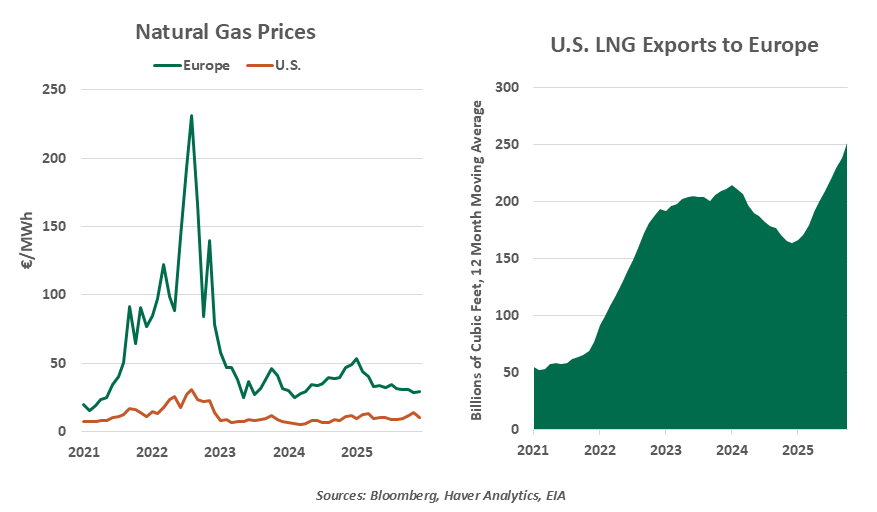
To assist, U.S. exports of liquified natural gas (LNG) to the EU have increased substantially in the last four years, an arrangement that has been very beneficial to both sides. But in the wake of rising transatlantic tensions, concerns have arisen that energy could be used as a bargaining chip in negotiations over trade or territory. Europe would be hard-pressed to make a second energy pivot in just five years.
Natural gas prices spiked this week in the wake of frigid conditions in the U.S. Climatically and diplomatically, we hope that a thaw is in our future.
Related Articles
Meet Our Team



Subscribe to Publications on Economic Trends & Insights
Gain insight into economic developments and our latest forecasts for the United States.
Information is not intended to be and should not be construed as an offer, solicitation or recommendation with respect to any transaction and should not be treated as legal advice, investment advice or tax advice. Under no circumstances should you rely upon this information as a substitute for obtaining specific legal or tax advice from your own professional legal or tax advisors. Information is subject to change based on market or other conditions and is not intended to influence your investment decisions.
© 2026 Northern Trust Corporation. Head Office: 50 South La Salle Street, Chicago, Illinois 60603 U.S.A. Incorporated with limited liability in the U.S. Products and services provided by subsidiaries of Northern Trust Corporation may vary in different markets and are offered in accordance with local regulation. For legal and regulatory information about individual market offices, visit northerntrust.com/terms-and-conditions.