
Weekly Economic Commentary | April 10, 2026
The Two Faces Of Cross-Border Travel
The travel sector has new challenges to navigate.
By Ryan Boyle
Our family enjoys flight-tracking apps. When a plane passes overhead, we can see exactly where it is going. As we zoom out, we can get a sense of broader patterns.
Over the past several years, those patterns have been changing. The evolving flows of both tourists and emigrees will have important economic effects.
The leisure travel market had a prolonged slump during the pandemic cycle. The U.N. World Tourism Organization reports that international tourist traffic only returned to its pre-COVID level in 2024. Passenger traffic then rose a further 4% in the full year 2025, reaching a new record of 1.52 billion tourists. Destinations across Europe are thriving, and North Africa stands out for rapid growth. Results were mixed in the Americas and Asia, with many Asian destinations still not recovering their 2019 volumes.
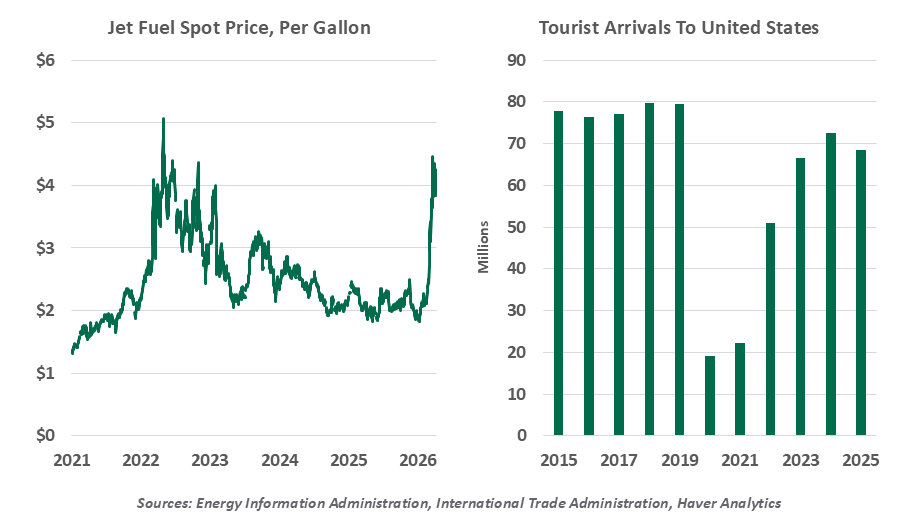
Coming into this year, some tourism markets were challenged. Policy developments led to some reconsideration of travel to the United States. Tighter U.S. visa policies and trade tensions have broadly weighed on demand. Canadian citizens notably embraced domestic alternatives. For the full year 2025, Canada border crossings fell 22% to 15.9 million, a level last seen in 2006 (outside of the pandemic border closure).
The pandemic caused a lasting change to Chinese travel patterns. No longer eager world travelers, many Chinese travelers have refocused on domestic destinations. Chinese arrivals to the U.S. are down by half from their pre-pandemic level; diplomatic tensions spurred a 60% decrease in Chinese travel to Japan. The change in behavior runs in both directions, as international arrivals to China are also down by more than half from their 2019 volumes. Amid a slower economic outlook, more Chinese residents are exploring their own country, keeping their tourism sector afloat.
Travel has been hindered by global tensions and rising costs.
The Iran conflict has added more complications. Potential travelers begin their plans with a budget. Households around the world now find their funds squeezed by higher energy prices. Discretionary spending can be curtailed to absorb the higher costs of essentials like motor fuel, but planning for the cost of airfare will prove difficult. Airlines’ financial reports show fuel is at least 20% of their overall costs; jet fuel prices are gaining even faster than crude oil. Several airlines have already announced fuel surcharges and reductions to less-traveled routes.
Some travel-dependent economies will struggle in the months ahead. Japan has enjoyed a surge in tourism thanks to a weak yen. Italy has also stood out as a good value, especially for Americans spending higher-value dollars. Those markets may lose some of their allure. Emerging markets are at risk; tourism is fundamental to the economies of warm equatorial nations from the Caribbean Sea to the South Pacific.
Tourists are not the only people on the move. Business travel represents a majority of airfares, and this source of demand will also be challenged. The Global Business Travel Association reported a slowdown, from 10% growth in 2024 to only 7% in 2025, with a forecast of a similar growth rate in 2026. Many businesses are looking to save expenses on travel amid widespread cost pressures.
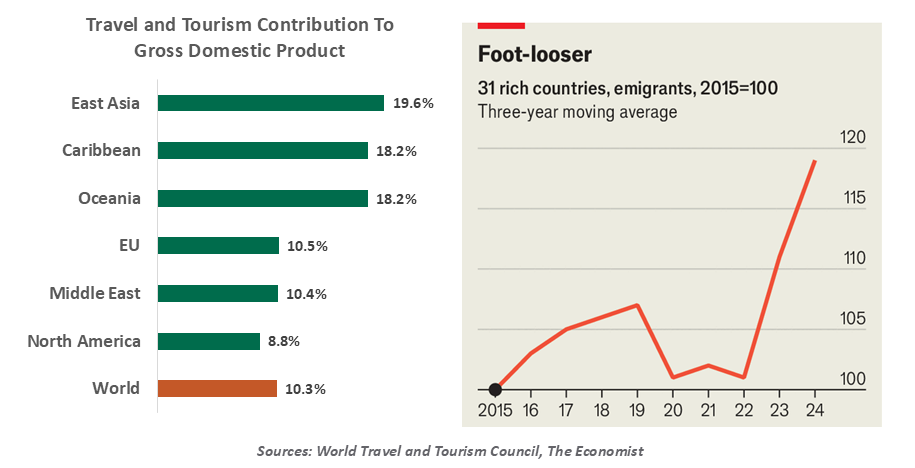
Some international travelers hold only one-way tickets. Data on emigration is not consistently collected, complicating the identification of these moves. Researchers at The Economist examined data across 31 advanced economies and estimated four million people made permanent departures in 2024, about 20% more than the pre-pandemic trend.
Some of the increase was an unwind of temporary stays. Immigration surged after pandemic restrictions eased, but many intended to stay for limited periods. Transient residents making their return would appear to be permanent departures.
Higher-skilled workers are more likely to find opportunities outside of their home countries and welcome the new experience. Working from anywhere is a real possibility for many remote positions, especially with multinational firms. A worker may be able to move around the world without ever leaving the job they held before departure.
Tax arbitrage may motivate some moves. Higher earners have more to gain by relocating, even temporarily, to lower-tax jurisdictions. The United States requires its citizens to pay domestic taxes on income earned abroad, but citizens of most other nations do not face the same policy.
Permanent international relocation is on the rise.
Wealthier retirees may also change their domiciles to reduce taxes on their income and estates.Dissatisfaction with a citizen’s home leadership and policies may also prompt a look at foreign possibilities. The United Arab Emirates saw a surge in expatriate population, particularly Britons.
For permanent departures, one nation’s loss is another’s gain. Nations experiencing departures lose priceless human capital, as well as tangible income taxes. A declining population can compound upon itself, as citizens with the most potential see their best opportunities abroad. immigration-friendly nations like Canada and Australia have gained productive workers, but have needed to moderate their policies in light of resource constraints and political pressure.
My most recent flight met rough weather at its destination and was rerouted to another city. The airport’s ability to manage our unplanned arrival was a display of resiliency. Volatile flows of people will demand adaptability by all nations, whether keeping their tourism sector afloat or managing shifts in the labor force. No amount of planning can prevent some turbulence along the way.
Related Articles
Meet Your Expert
Ryan Boyle
Chief U.S. Economist
Ryan James Boyle is the Chief U.S. Economist within the Global Risk Management division of Northern Trust. In this role, Ryan is responsible for briefing clients and partners on the economy and business conditions, supporting internal stress testing and capital allocation processes, and publishing economic commentaries.

Meet Our Team


Subscribe to Publications on Economic Trends & Insights
Gain insight into economic developments and our latest forecasts for the United States.
Information is not intended to be and should not be construed as an offer, solicitation or recommendation with respect to any transaction and should not be treated as legal advice, investment advice or tax advice. Under no circumstances should you rely upon this information as a substitute for obtaining specific legal or tax advice from your own professional legal or tax advisors. Information is subject to change based on market or other conditions and is not intended to influence your investment decisions.
© 2026 Northern Trust Corporation. Head Office: 50 South La Salle Street, Chicago, Illinois 60603 U.S.A. Incorporated with limited liability in the U.S. Products and services provided by subsidiaries of Northern Trust Corporation may vary in different markets and are offered in accordance with local regulation. For legal and regulatory information about individual market offices, visit northerntrust.com/terms-and-conditions.