
Weekly Economic Commentary | February 20, 2026
U.S. Fiscal Situation: Still Sliding
New policies have not changed the sobering fiscal outlook.
By Ryan Boyle
Routine physical checkups are an important component of healthcare. A doctor can identify potential problems and coach the patient toward making healthier choices.
The U.S. has just had a visit with a fiscal specialist, and the diagnosis is sobering. The Congressional Budget Office (CBO) released its first ten-year budget outlook incorporating last year’s “One Big Beautiful” reconciliation bill. The report sees annual deficits remaining near $2 trillion, or 6% of gross domestic product (GDP), in the years ahead. The national debt is on track to rise to 120% of GDP in 2036, from about 100% now.
The CBO makes as few assumptions as possible in their outlook. Future income tax rates are held steady; tariff revenues are assumed to peak in 2026, then decline gradually as imports are substituted. Paths for GDP growth, inflation and employment are all consistent with a stable economy.
Lower discretionary spending can’t offset higher interest payments and entitlements.
But the CBO could not discount today’s headwinds. The primary driver of rising deficits is mandatory entitlement spending for a growing cohort of retirees. Population growth was downgraded to reflect lower rates of immigration. Borrowing costs assume a long-run 10-year Treasury yield of 4.4%, and an overnight borrowing rate of 3.4%, very close to current rates. As older, lower-cost bonds are retired, new debt will be more costly. An indebted nation paying higher interest rates will struggle to avoid a path of rising debt.
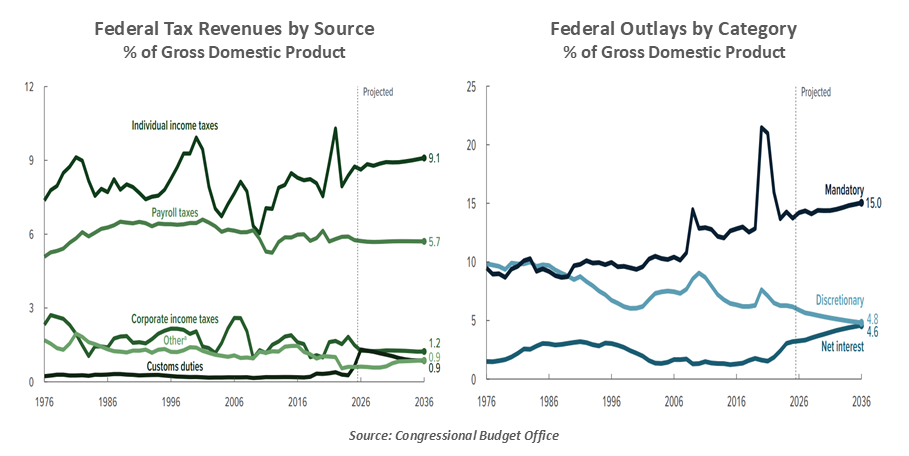
Few remedies remain to cut government spending. For the full year 2025, federal government employment fell by 323,000 people, or over 10%. The Department of Government Efficiency took novel approaches to cutting spending within the powers of the executive branch; further reductions will require acts of Congress. Leadership may eventually have to consider raising tax revenue, but that difficult discussion will be deferred as long as possible.
After a stern lecture at the annual physical, it’s up to the patient to actually change behavior. Long-running habits can be curbed by building on small gains. Establishing an appetite for small government is a step toward fiscal balance, but the recovery will not be easy.
Related Articles
Meet Your Expert
Ryan Boyle
Chief U.S. Economist
Ryan James Boyle is the Chief U.S. Economist within the Global Risk Management division of Northern Trust. In this role, Ryan is responsible for briefing clients and partners on the economy and business conditions, supporting internal stress testing and capital allocation processes, and publishing economic commentaries.
Meet Our Team


Subscribe to Publications on Economic Trends & Insights
Gain insight into economic developments and our latest forecasts for the United States.
Information is not intended to be and should not be construed as an offer, solicitation or recommendation with respect to any transaction and should not be treated as legal advice, investment advice or tax advice. Under no circumstances should you rely upon this information as a substitute for obtaining specific legal or tax advice from your own professional legal or tax advisors. Information is subject to change based on market or other conditions and is not intended to influence your investment decisions.
© 2026 Northern Trust Corporation. Head Office: 50 South La Salle Street, Chicago, Illinois 60603 U.S.A. Incorporated with limited liability in the U.S. Products and services provided by subsidiaries of Northern Trust Corporation may vary in different markets and are offered in accordance with local regulation. For legal and regulatory information about individual market offices, visit northerntrust.com/terms-and-conditions.