
Asset Servicing | October 9 2026
Structural Shifts: Scaling, Innovation and Fit for the Future
Northern Trust’s UK Asset Owners Client Summit 2026 brought together pension leaders, asset owners and market practitioners to examine two themes moving rapidly up institutional agendas: pension scheme consolidation and tokenisation. Across both discussions, the focus has shifted from concept to execution. The conversation centered on how asset owners can navigate structural change while maintaining strong governance and delivering improved outcomes for members.
Polling throughout the event reinforced a consistent picture. Consolidation is no longer a hypothetical trend, and tokenisation is no longer a distant innovation. In both cases, the challenge has become more practical: how to implement change in a controlled way, select the right models, and translate structural shifts into tangible benefits.
Consolidation is accelerating, but not uniform
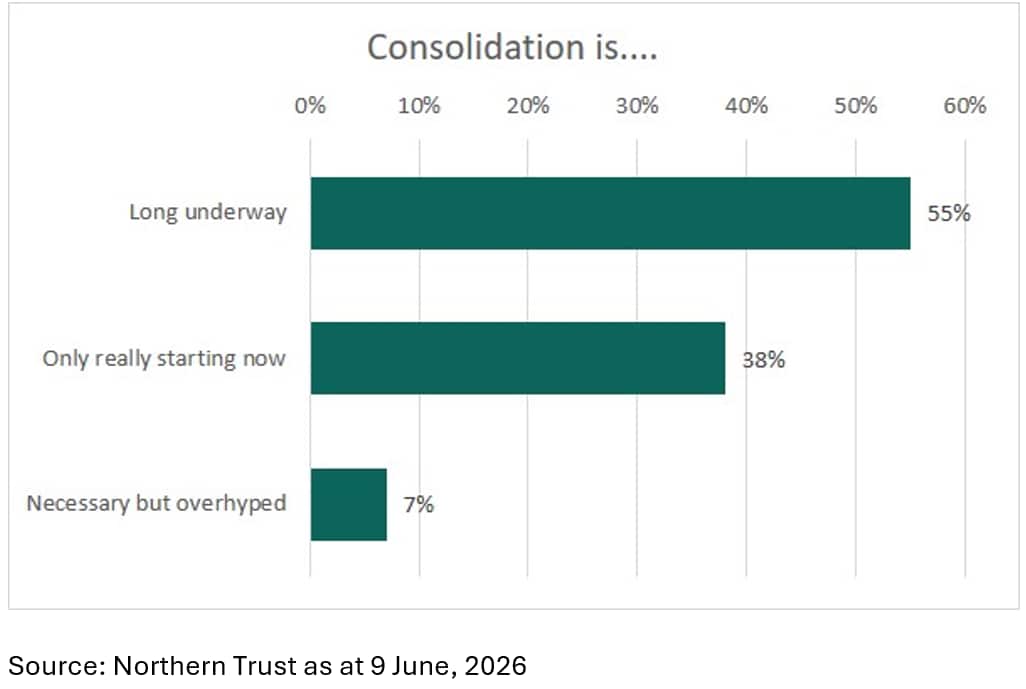
The discussion on pension scheme consolidation reflected a market already in motion. A majority of attendees (55%) said consolidation is “long underway and gathering pace,” while 38% felt it is “only really starting now.”
This divergence reflects the reality that consolidation is unfolding differently across segments. For defined benefit (DB) schemes, improved funding positions and improved buyout affordability have accelerated risk transfer activity. Transaction volumes have increased significantly in recent years, reshaping the market. For defined contribution (DC) schemes, policy initiatives, governance burdens and scale requirements are pushing smaller schemes to reassess their long-term viability. For Local Government Pension Schemes (LGPS), pooling structures continue to evolve under regulatory direction, aiming to deliver scale while maintaining local accountability.
Despite these differences, a common theme emerged: consolidation is not a single pathway. It encompasses pooling, buy-in and buy-out activity, transfers to master trusts, superfund solutions and emerging structures such as the collective defined contribution (CDC) schemes. Each model offers different trade-offs across governance, cost, flexibility and member outcomes.
Poll question #1
Consolidation is...
Scale is valued, but not in isolation
The panel was clear that scale can deliver benefits, but only when it is applied effectively. Larger structures may support stronger governance, access to specialist capabilities and more resilient operating models, as well as investment in infrastructure, technology and servicing capabilities that smaller schemes may find difficult to sustain.
The role of scale, however, differs by scheme type. For DB schemes and the LGPS, it is often linked to governance, cost efficiency, investment strategy, risk management and endgame planning, with member outcomes typically affected indirectly because benefits are promised or guaranteed. For DC schemes, the link is more direct: if used well, scale can create efficiencies and broaden investment opportunities in ways that may improve member outcomes.
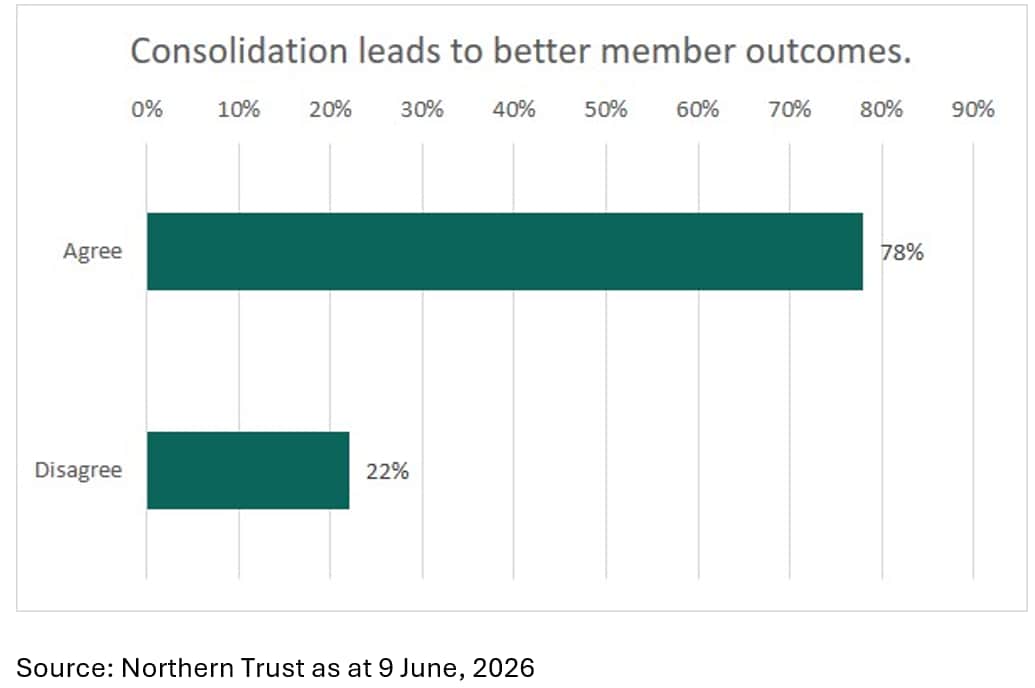
Scale alone is not sufficient. The discussion repeatedly returned to fiduciary duty and member outcomes as the primary benchmark. While 78% of attendees agreed that consolidation leads to better member outcomes, panellists emphasised that this is not automatic.
Scale must be accompanied by robust governance, clear accountability and effective implementation. There is also recognition that excessive scale can introduce its own challenges, including reduced flexibility and potential constraints in accessing certain investment opportunities.
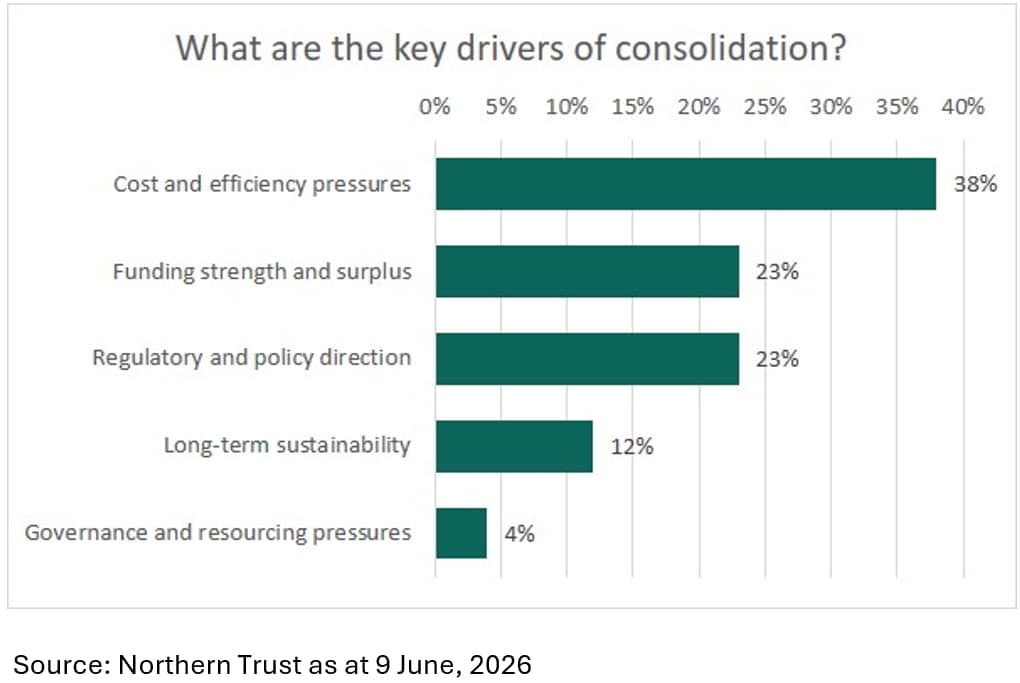
This nuance is reflected in the drivers of consolidation identified by attendees. Cost and efficiency pressures ranked highest (38%), followed by funding strength and regulatory direction (both 23%). These responses point to a combination of financial, operational and policy forces shaping the trend, rather than a single dominant factor.
Poll question #2
What are the key drivers of consolidation?
Poll question #3
Consolidation leads to better outcomes
The real challenge is choosing the right model
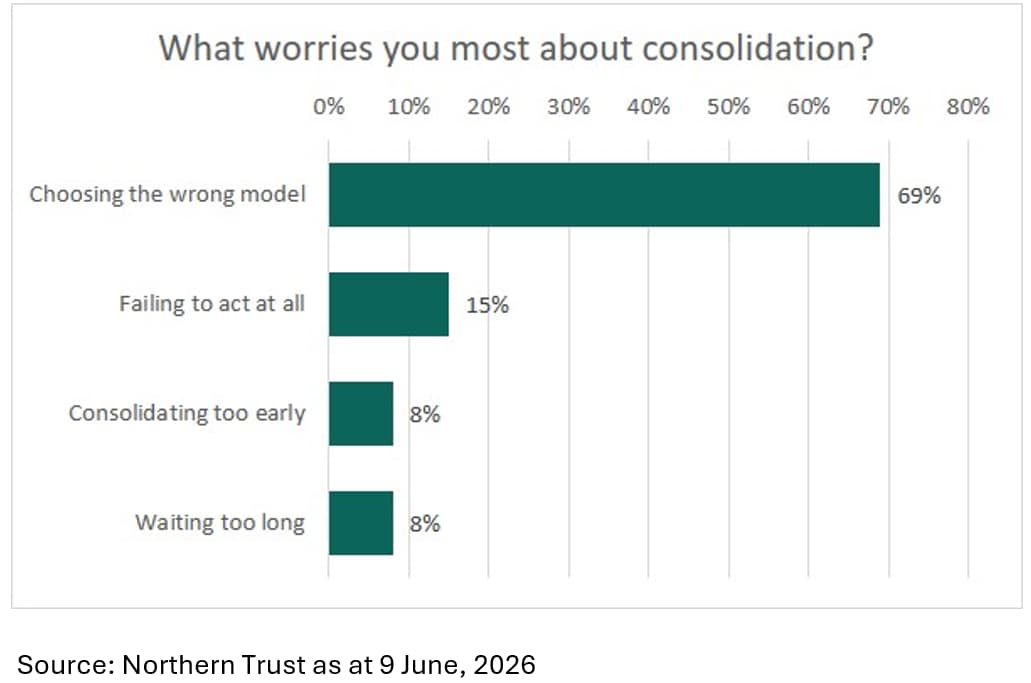
If consolidation is inevitable, the critical question becomes how to approach it. Polling showed that 69% of respondents see “choosing the wrong model” as the biggest concern, far outweighing fears of acting too early or too late.
This reflects a growing complexity in the decision-making landscape. With multiple end-state options, asset owners must evaluate not just whether to consolidate, but how. Each pathway involves different implications for governance, cost, member experience and long-term strategy.
Preparation emerged as a decisive factor. Panellists highlighted that schemes which have invested in data quality, governance frameworks and clear decision processes are better positioned to act effectively. Well-prepared schemes are more likely to achieve favourable outcomes, move efficiently through transactions and retain control over their strategic direction. By contrast, a lack of preparation can lead to delays, increased costs and suboptimal decision-making.
Poll question #4
What worries you most about consolidation?
Tokenisation is moving toward practical application
The second half of the event focused on tokenisation, shifting the discussion away from crypto assets and toward institutional use cases. The discussion emphasised that tokenisation should not be viewed as a departure from established investment processes, but as an opportunity to deliver familiar investment structures with improved efficiency, enhanced collateral mobility and more streamlined operational workflows. The focus was on achieving better outcomes through modernised infrastructure rather than creating entirely new investment products.
Examples highlighted included tokenised funds, digital gilts, improved settlement mechanisms and enhanced collateral mobility. Rather than replacing existing systems outright, the emphasis was on making them “the same, but better”: maintaining familiar investment structures, governance and investor protections while reducing operational friction and improving how assets are issued, held and transferred.
What has changed in recent years is the level of regulatory engagement and market participation. Regulatory clarity is improving, and initiatives such as the UK digital gilt pilot signal increasing institutional support. This is helping shift tokenisation from a conceptual discussion toward practical implementation.
Adoption remains cautious
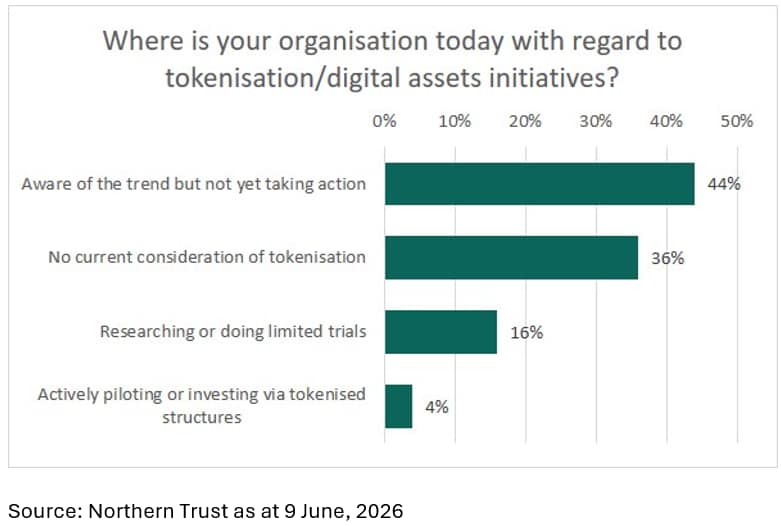
Despite this progress, institutional adoption is still at an early stage. Event polling showed that 44% of organisations are aware of the trend but not yet taking action and 36% say tokenisation is not yet on their radar, with only a small minority actively involved.
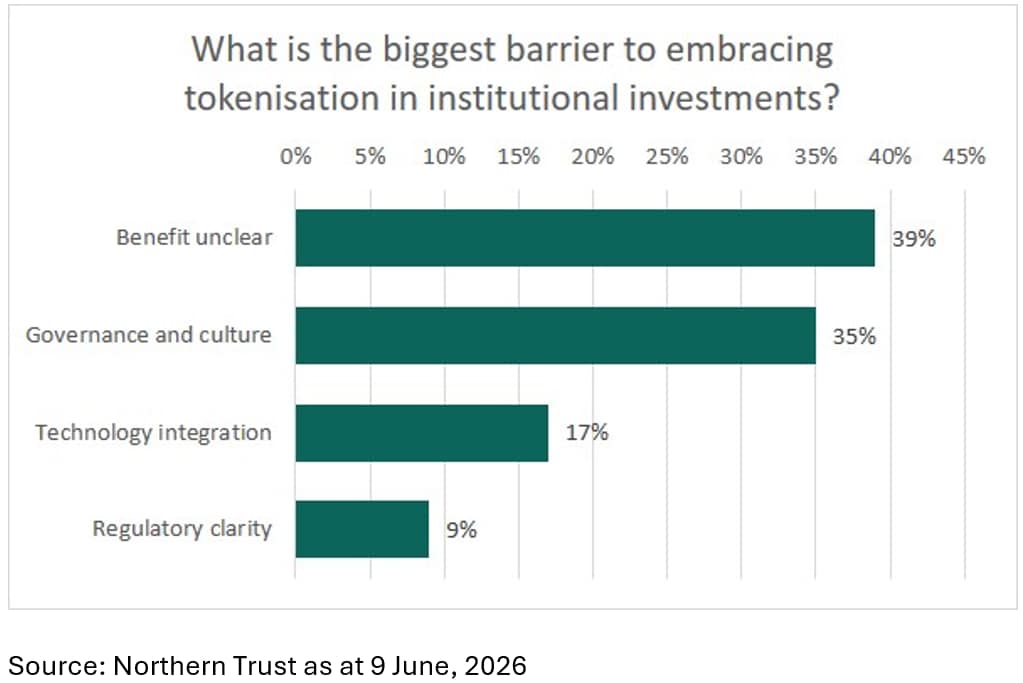
In the room, the barriers appeared to be evolving. Regulatory uncertainty, remained relevant, but attendees pointed more strongly to unclear value-add and governance or cultural challenges as the main barriers to adoption.
These responses suggest that the key hurdle is not access to the technology, but conviction. Asset owners are asking what tokenisation improves in practice, and whether those improvements justify the effort and change required to adopt it.
This caution should be viewed alongside broader asset owner survey findings, which indicate that digital asset exposure is becoming more established among institutional investors, even if tokenisation-specific activity remains at an earlier stage. The survey suggests that the market is not starting from zero: asset owners are increasingly familiar with digital asset themes, but are still assessing where tokenisation delivers a sufficiently clear benefit for long-term portfolios and operating models.
Poll question #5
Where is your organisation today with regard to tokenisation / digital assets initiatives?
Demonstrating value will be critical
Panellists focused on practical use cases to address that question. Potential benefits include improved collateral mobility, reduced operational costs, faster settlement and greater transparency in ownership records. For asset owners, the practical relevance may be less about accessing a new asset class and more about whether tokenisation can improve existing market processes, including collateral management, transfer agency, fund administration and the movement of assets across market participants.
However, achieving these benefits will depend on integration with existing market infrastructure. Trusted service providers, familiar governance frameworks, robust custody arrangements, fund administration capabilities, reporting and regulatory oversight will be essential if tokenised markets are to scale successfully. Tokenisation is unlikely to gain traction as a standalone innovation; it will need to fit within the established ecosystem and demonstrate clear incremental value.
For most asset owners, the near-term priority is not wholesale adoption, but informed engagement. That means building internal understanding, asking managers and providers how tokenisation could benefit existing investment and operating models, monitoring regulatory developments and identifying where future use cases may support governance, efficiency or member outcomes.
Poll question #6
What is the biggest barrier to embracing tokenisation in institutional investments?
A shift from theory to execution
Across both themes, the overarching message of the summit was consistent: the industry is moving into a more execution-focused phase.
In consolidation, the debate is no longer about whether change is coming, but about selecting the right model and preparing effectively. In tokenisation, the conversation is shifting from potential to practical application, with a growing emphasis on demonstrable outcomes, operational feasibility and integration with trusted market infrastructure.
For asset owners, the common challenge is disciplined decision-making: understanding where structural change can support strong governance, efficiency and a clear linkage between innovation and member outcomes. Those that can navigate this transition thoughtfully will be best positioned to capture the benefits of structural change while managing risk effectively.
2026 Global Asset Owner Peer Study
© 2026 Northern Trust Corporation. Head Office: 50 South La Salle Street, Chicago, Illinois 60603 U.S.A. Incorporated with limited liability as an Illinois corporation under number 0014019. Products and services provided by subsidiaries of Northern Trust Corporation may vary in different markets and are offered in accordance with local regulation. This material is directed to professional clients (or equivalent) only and is not intended for retail clients and should not be relied upon by any other persons. The contents of this communication should not be construed as a recommendation, solicitation or offer to buy, sell or procure any securities or related financial products or to enter into an investment, service or product agreement in any jurisdiction in which such solicitation is unlawful or to any person to whom it is unlawful. This communication does not constitute investment advice, does not constitute a personal recommendation and has been prepared without regard to the individual financial circumstances, needs or objectives of persons who receive it. Moreover, it neither constitutes an offer to enter into an investment, service or product agreement with the recipient of this document nor the invitation to respond to it by making an offer to enter into an investment, service or product agreement. For Asia-Pacific markets, this communication is directed to expert, institutional, professional and wholesale clients or investors only and should not be relied upon by retail clients or investors. For legal and regulatory information about our offices and legal entities, visit northerntrust.com/disclosures. The views, thoughts, and opinions expressed in the text belong solely to the author, and not necessarily to the author's employer, organization, committee or other group or individual.
The following information is provided to comply with local disclosure requirements: The Northern Trust Company, London Branch, Northern Trust Global Investments Limited, Northern Trust Securities LLP, Northern Trust Global Services SE UK Branch and Northern Trust Investor Services Limited, 50 Bank Street, London E14 5NT, are authorised and regulated by the UK’s Financial Conduct Authority. The Northern Trust Company, London Branch and Northern Trust Global Services SE UK Branch are also authorised and regulated by the UK’s Prudential Regulation Authority. Not all of the products and services mentioned within this material are authorised and regulated by the UK’s Financial Conduct Authority or UK’s Prudential Regulation Authority. Northern Trust Global Services SE, 10 rue du Château d’Eau, L-3364 Leudelange, Grand-Duché de Luxembourg, incorporated with limited liability in Luxembourg at the RCS under number B232281; authorised by the ECB and subject to the prudential supervision of the ECB and the CSSF; Northern Trust Global Services SE UK Branch, UK establishment number BR023423 and UK office at 50 Bank Street, London E14 5NT; Northern Trust Global Services SE Sweden Bankfilial, Ingmar Bergmans gata 4, 1st Floor, 114 34 Stockholm, Sweden, registered with the Swedish Companies Registration Office (Sw. Bolagsverket) with registration number 516405-3786 and the Swedish Financial Supervisory Authority (Sw. Finansinspektionen) with institution number 11654; Northern Trust Global Services SE Netherlands Branch, Viñoly 6th & 7th floor, Claude Debussylaan 16A-18A, 1082 MD Amsterdam, the Netherlands. Subject to regulation in the Netherlands by De Nederlandsche Bank and Autoriteit Financiële Markten. Northern Trust Global Services SE Abu Dhabi Branch, registration Number 000000519 licenced by ADGM under FSRA #160018; Northern Trust Global Services SE NUF, org. no. 925 952 567 (Foretaksregisteret), address Third Floor, Haakon VIIs gate 6 0161 Oslo, is a Norwegian branch of Northern Trust Global Services SE supervised by Finanstilsynet. Northern Trust Global Services SE Leudelange, Luxembourg, Zweigniederlassung Basel is a branch of Northern Trust Global Services SE. The Branch has its registered office at Grosspeter Tower, Grosspeteranlage 29, 4052 Basel, Switzerland, and is authorised and regulated by the Swiss Financial Market Supervisory Authority FINMA. The Northern Trust Company Saudi Arabia, PO Box 7508, Level 20, Kingdom Tower, Al Urubah Road, Olaya District, Riyadh, Kingdom of Saudi Arabia 11214-9597, a Saudi Joint Stock Company – capital 52 million SAR. Regulated and Authorised by the Capital Market Authority License #12163-26 CR 1010366439. Northern Trust (Guernsey) Limited (2651) (NTGL)/Northern Trust Fiduciary Services (Guernsey) Limited (29806) (NTFSGL)/Northern Trust International Fund Administration Services (Guernsey) Limited (15532) (NTIFASGL) are licensed by the Guernsey Financial Services Commission. Registered Office: NTGL/NTFSGL -Trafalgar Court, Les Banques, St Peter Port, Guernsey GY1 3DA. NTIFASGL - Trafalgar Court, Les Banques, St Peter Port, Guernsey GY1 3QL. Northern Trust International Fund Administration Services (Ireland) Limited (160579)/Northern Trust Fiduciary Services (Ireland) Limited (161386) and The Northern Trust Company, Ireland Branch (910415) are authorised and regulated by the Central Bank of Ireland. Registered Office: Georges Court, 54-62 Townsend Street, Dublin 2, D02 R156.