Holding The Line
Asia-Pacific has navigated the shifting trade terrain with measured resilience.
2025 has not been just a story of U.S. resilience. The Asia-Pacific (APAC) region has weathered storms and stayed firmly on course. The worst trade outcomes have been avoided, with tariffs settling at lower rates than threatened at the start of the year by the U.S. administration. Export momentum has held up better than expected, buoyed by strong demand for electronics and robust intra-regional trade. Inflation has settled into a steadier rhythm across much of the region.
But beneath the hood lies a complex interplay of shifting trade gears and policy recalibration. The old roadmaps of globalization no longer apply. To keep the growth engine running smoothly, the region will not only have to endure but evolve. Asia Pacific’s growth prospects will be defined by the ability of regional economies to rewire trade relationships and fine-tune policy to meet demands of new economic realities.
Following are our views on how major APAC markets are poised to perform.
Japan
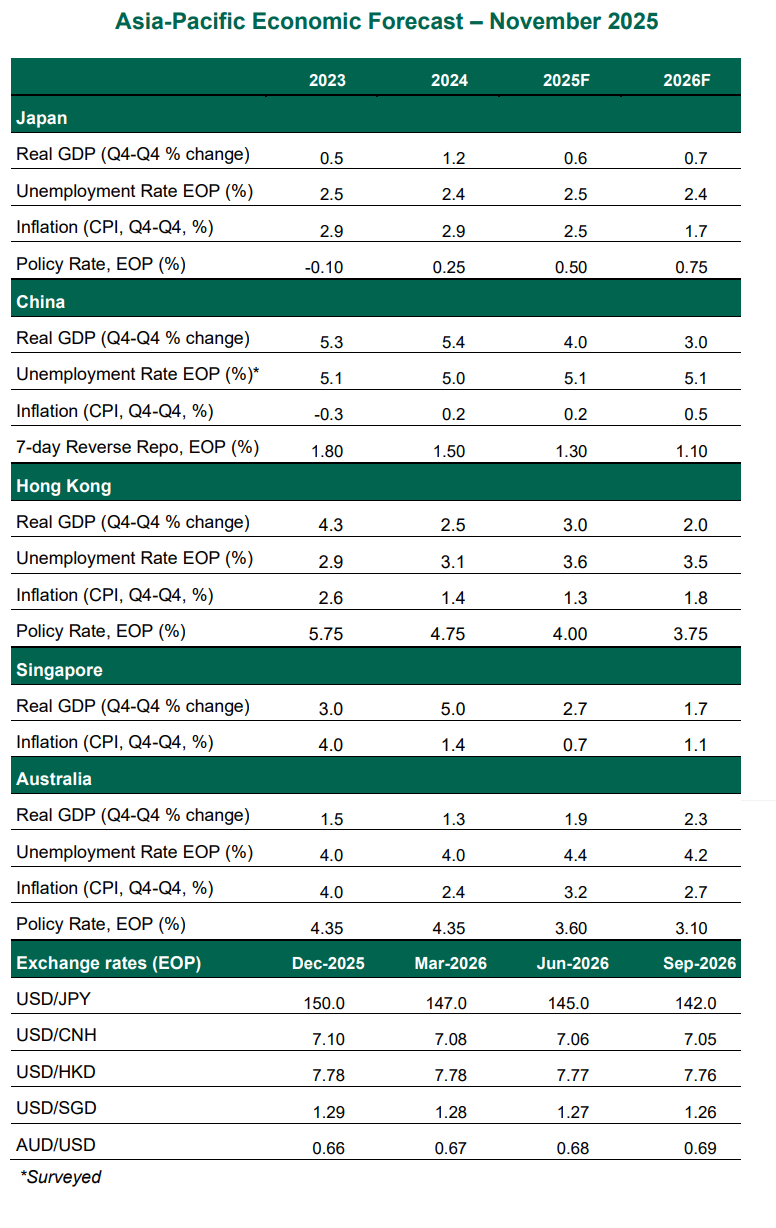
- Growth in the second quarter was revised upward, reflecting healthier consumption and inventory investment; we have upgraded our growth outlook for this year accordingly. However, this has not changed the outlook of a slow environment for exports, leaving a challenging landscape for the business sector. Japan has been a frontrunner in its efforts to negotiate a more sophisticated deal with the United States, pledging $550 billion of future investment. However, even the most generous concessions are unlikely to restore its former terms of trade.
- Support for growth will need to come from Japanese consumers, but they will be challenged by persistent inflation and a weakened currency. Real wage growth has turned negative, eroding purchasing power. The Bank of Japan held the policy rate steady at 0.5% at the October meeting, amid uncertainty over the outlook for domestic wage gains and its largest export market, the United States. We continue to expect the next rate hike in early 2026, though risks are tilted toward an earlier move as policymakers weigh the trade-off between rising borrowing costs and the risk of further currency depreciation.
China
- Presidents Trump and Xi agreed to extend their tariff truce by one year during their talks in South Korea. The U.S agreed to a 10 percentage point reduction in tariffs on Chinese goods. In return, China agreed to suspend its recently announced rare earth export control measures and resume imports of U.S. soybeans. Both sides also committed to postponing the imposition of higher docking fees on each other’s shipping fleets. While this helped avoid another flare-up in tensions, a comprehensive deal remains elusive, with major issues still unresolved.
- China’s economy is holding steady, with gross domestic product (GDP) growing 4.8% year-on-year in the third quarter; the government’s 5% annual target is within reach. But momentum is weakening. Domestic demand is soft, weighed down by weak consumer sentiment, persistent deflation and a deepening property market slump. Government efforts to stimulate activity and stabilize the real estate sector have so far yielded limited results. The People’s Bank of China has maintained a steady policy stance, but fiscal support is waning, and the timing of any new stimulus is uncertain.
Singapore
- Real GDP growth slowed down from 4.5% year over year in the second quarter to 2.9% in the three months to September. However, the moderation was smaller than expected, as manufacturing activity helped partially offset the pullback in services and construction. Re-exports have benefitted from trade front-loading and are expected to continue gaining from one of the lowest new effective tariff rates in the United States. While growth is expected to hold steady in the near-term, America’s increasing scrutiny of transshipment activities could pose a significant risk to Singapore.
- In its October monetary policy meeting statement, the Monetary Authority of Singapore (MAS) decided to keep its policy band for the Singapore dollar unchanged. Resilient growth and the recent uptick in core inflation, if sustained, have raised the risk of the MAS maintaining its current policy stance for an extended period.
Hong Kong
- Near-term prospects for Hong Kong are improving. GDP growth accelerated to 3.8% year over year in the third quarter, up from 3.1% in the previous quarter, supported by stronger exports and consumption. Equity markets are rallying. The residential property market is showing early signs of recovery, aided by falling borrowing costs and policy support, including the lowering of investment thresholds for migrants. House prices rose on an annual basis in September for the first time since the pandemic. The recent agreement between Washington and Beijing bodes well for Hong Kong. However, structural tensions in U.S.-China relations, a protracted slowdown in Mainland China, and weakness in the domestic labor market are key risks to a more meaningful recovery.
- Following the 25-basis point reduction by the U.S. Federal Reserve last month, the Hong Kong Monetary Authority lowered its base rate to 4.25%. With the Fed expected to continue easing, monetary conditions in Hong Kong are likely to become more supportive of growth. For a financial hub like Hong Kong, easier financial conditions and lower local funding costs will be critical in sustaining improvement.
Australia
- Australia’s economy is sending mixed signals. After trending down in the middle of the year, inflation breached the upper end of the Reserve Bank of Australia’s (RBA) 2%-3% target range. Unemployment rose to 4.5% in September, the highest level in four years, suggesting the jobs market is cooling. Despite the rise in unemployment, hours worked increased in September, hinting at a potential rebound in productivity. Domestic demand, which has been resilient, could suffer from labor market slack.
- At its November meeting, the RBA held rates steady over renewed concerns about inflation. The RBA lifted its near-term inflation forecasts and indicated that it is in no rush to begin cutting interest rates. While slower household spending should ease inflationary pressures going forward, we now anticipate the timeline for reaching a neutral policy setting has been pushed out to mid-2026.
Meet Our Team



Subscribe to Publications on Economic Trends & Insights
Gain insight into economic developments and our latest forecasts for the United States.
Information is not intended to be and should not be construed as an offer, solicitation or recommendation with respect to any transaction and should not be treated as legal advice, investment advice or tax advice. Under no circumstances should you rely upon this information as a substitute for obtaining specific legal or tax advice from your own professional legal or tax advisors. Information is subject to change based on market or other conditions and is not intended to influence your investment decisions.
© 2026 Northern Trust Corporation. Head Office: 50 South La Salle Street, Chicago, Illinois 60603 U.S.A. Incorporated with limited liability in the U.S. Products and services provided by subsidiaries of Northern Trust Corporation may vary in different markets and are offered in accordance with local regulation. For legal and regulatory information about individual market offices, visit northerntrust.com/terms-and-conditions.