
Weekly Economic Commentary | November 26, 2025
Of Turkey And Tariffs
Food prices are a constant reminder of inflation.
By Carl Tannenbaum
Editor’s Note: As is our custom, we’re publishing a short note on food in advance of the Thanksgiving weekend. For those celebrating the holiday, we hope the time with friends and family proves restorative.
We have a crowd of about 30 people coming to Thanksgiving dinner. Feeding all of them will require a lot of preparation, but that may not be our biggest challenge. Finding places for all of them to sit and making sure that certain people sit far away from certain other people is absorbing a great deal of attention. We’ve had a few food fights on the holiday in the past, and I’d like to spare my carpeting.
The inflated number of guests will contribute to significant inflation in the cost of the meal. Fortunately, the American Farm Bureau Federation estimates that prices for the items on this year’s Thanksgiving buffet have declined by 5% since last year. Avian flu has afflicted turkey flocks in the last month, but the frozen birds used by most American cooks have been unaffected.
Moderation in the cost of the holiday meal is welcome, but food prices otherwise are on the rise. Tariffs are one of the main reasons why.
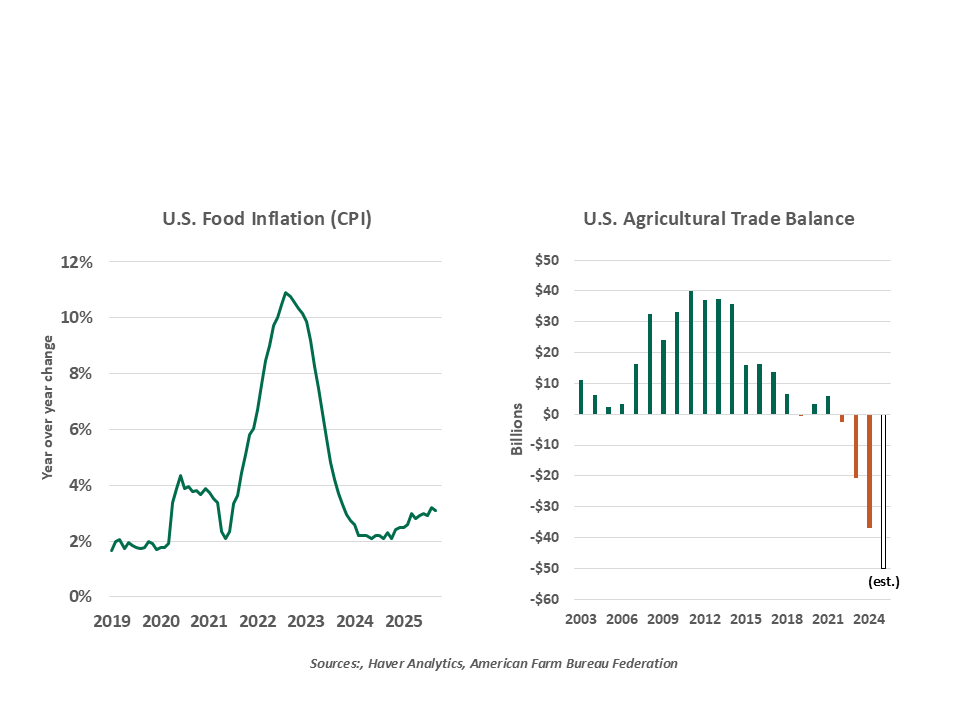
The United States is a country of abundance. Its agricultural production ranks third in the world, and it exports twice as much food as any other nation. Nonetheless, the U.S. had a trade deficit in food of almost $32 billion last year, and the shortfall is projected to be even larger this year.
There are several basic reasons for this. While the U.S. has immense surpluses of grains like corn and soybeans, it has deficits for fruits and vegetables. The growing season in the U.S. is limited by climate, so securing year-round availability requires bringing produce in from overseas. Americans also have appetites for foods that cannot easily be grown in the United States. Coffee and bananas are two leading examples.
This year’s trade friction has hit the agricultural sector in a number of ways. Foods were not exempt from the across-the-board reciprocal tariffs announced in April; supplemental levies on particular countries followed. This raised the cost of inbound shipments, and prices to U.S. consumers. The Tax Foundation estimates that almost three-quarters of American food imports are being assessed higher import taxes than they were at the start of 2025.
In retaliation for U.S. tariffs, several countries struck back by sanctioning U.S. exports. China once again banned soybean imports in May, replacing them with supply from South America. Canada placed 25% tariffs on all U.S. imports in May, responding to charges imposed by Washington.
This year’s trade battles have been particularly hard on agriculture.
These circumstances have produced the unwelcome combination of higher prices for consumers and poor results for farmers. The economic and political ramifications of this have led Washington to change course.
Recent negotiations with China and Canada have resulted in the removal of the most punitive restrictions on agricultural imports. The U.S. Department of Agriculture is considering increasing levels of relief to growers who have struggled to sell their crops.
To improve affordability, the Administration recently dropped tariffs against a range of foodstuffs, including coffee. While households can substitute away from many products when they become more expensive, coffee drinkers are a dedicated lot. The 19% increase in the cost of morning joe over the last year has created considerable discontent.
The policy retreat is a subtle admission that tariffs are, in the main, being paid by households. And while food prices aren’t considered in measures of “core” inflation, they have an outsized influence in peoples’ perceptions of inflation. Discomfort over the costs of living were a major factor in last year’s U.S. elections, and may have contributed to Democratic victories in the handful of races contested early this month. The politics of the pocketbook remain very powerful.
I wonder if AI could solve my Thanksgiving seating issue. Maybe I could ask it to create an interpersonal friction index, and create a table map that minimizes its value. Failing that, I hope that ChatGPT can provide tips for carpet cleaning.
Related Articles
Meet Our Team



Subscribe to Publications on Economic Trends & Insights
Gain insight into economic developments and our latest forecasts for the United States.
Information is not intended to be and should not be construed as an offer, solicitation or recommendation with respect to any transaction and should not be treated as legal advice, investment advice or tax advice. Under no circumstances should you rely upon this information as a substitute for obtaining specific legal or tax advice from your own professional legal or tax advisors. Information is subject to change based on market or other conditions and is not intended to influence your investment decisions.
© 2026 Northern Trust Corporation. Head Office: 50 South La Salle Street, Chicago, Illinois 60603 U.S.A. Incorporated with limited liability in the U.S. Products and services provided by subsidiaries of Northern Trust Corporation may vary in different markets and are offered in accordance with local regulation. For legal and regulatory information about individual market offices, visit northerntrust.com/terms-and-conditions.