
Weekly Economic Commentary | January 30, 2026
Europe's Long-Delayed Trade Pivot
The EU's moves show a global trade realignment underway.
By Vaibhav Tandon
Former U.S. President Dwight D. Eisenhower once observed that “what is important is seldom urgent, and what is urgent is seldom important.” The Europeans appeared to take this mantra at face value for many years, allowing strategically important trade negotiations with major economies to drift. Over the past few weeks, the European Union (EU) has shown a renewed urgency to conclude agreements that might help reduce reliance on the United States.
After more than two decades of talks, the EU has reached a free trade deal with Mercosur, the South American common market that includes Brazil, Argentina, Uruguay and Paraguay. More recently, Europe concluded an agreement with India, an accord nearly twenty years in the making. Taken together, these pacts signal a deliberate recalibration of Europe’s economic strategy in a world where trade has become increasingly weaponized. But it is the accord with India, branded as the ”mother of all deals,” that most clearly illustrates the shift in ambition.
Europe’s agreement with India lays the foundations for a free trade zone that links two billion people across continents. The deal eliminates or lowers tariffs on nearly 97% of EU exports, the most ambitious trade opening India has ever granted to a partner. Sectors such as alcohol, high-end automobiles, machinery and food will see steep tariff reductions, from as high as 150% down to 10%-50%. Levies on auto parts will be phased out over time. India will also open up government procurement to European firms.
Together, these measures will help double EU goods exports to India over the next six years. In exchange, more than 99% of Indian exports will gain preferential access to Europe, which will charge much lower tariffs for textiles, apparel, footwear and other labor-intensive manufactured goods.
The EU’s recent trade deals are big on intent, but reliance on the U.S. and China is still substantial.
Though smaller in scale, the Mercosur agreement will also create one of the world’s largest commerce zones, covering roughly 700 million consumers. Since 2000, the EU’s share of Mercosur trade has steadily declined from around 23% to 14%. The deal will dismantle tariffs on a wide range of European exports, from agricultural products and pharmaceuticals to cars and machinery. With current duties as high as 35% on auto parts and 28% on dairy, the pact is expected to boost exports to Mercosur countries by an estimated 39%, or about €50 billion per year, by 2040. The deal also makes it easier for EU countries to invest in Latin America’s critical raw materials, thereby strengthening Europe’s position in supply chains critical to green and digital transitions.
South American agricultural exporters stand to benefit from the reduction of European tariffs, a prospect that had triggered political pushback in member states such as France. To address these concerns, the agreement includes calibrated tariff rate quotas and a safeguard mechanism to restrict market access for sensitive products in the event of import surges. The sector is further protected by stricter compliance controls, closer alignment of production standards, and a €6.3 billion Unity Safety Net from 2028 to shield European farmers from market disruptions.
The overall economic gains from these two arrangements, however, are likely to be modest. They are projected to lift European gross domestic product by just 0.1% by 2040, compared with a gain of up to 0.7% for Mercosur economies.
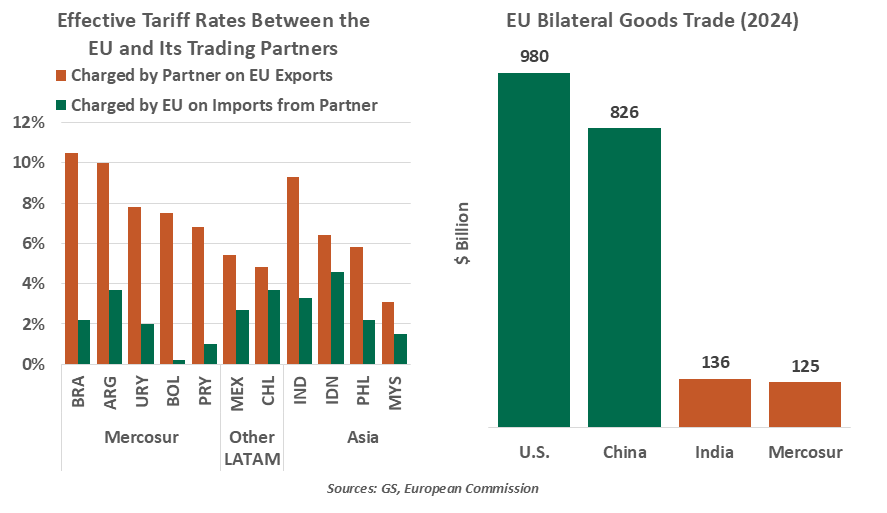
Though meaningful, these agreements will not reshape Europe’s economic fortunes or neutralize external headwinds. India and Mercosur goods trade combined amounts to $260 billion a year, one-fourth of the $1 trillion annual flow with the United States. Therefore, only a fraction of the lost exports to the U.S. are likely to be recovered.
Even so, after years of living by Eisenhower’s words, Europe has finally recognized the importance of more diversified trade relations and acted with urgency to meet this goal. Expect more to come on this front.
Related Articles
Meet Our Team



Subscribe to Publications on Economic Trends & Insights
Gain insight into economic developments and our latest forecasts for the United States.
Information is not intended to be and should not be construed as an offer, solicitation or recommendation with respect to any transaction and should not be treated as legal advice, investment advice or tax advice. Under no circumstances should you rely upon this information as a substitute for obtaining specific legal or tax advice from your own professional legal or tax advisors. Information is subject to change based on market or other conditions and is not intended to influence your investment decisions.
© 2026 Northern Trust Corporation. Head Office: 50 South La Salle Street, Chicago, Illinois 60603 U.S.A. Incorporated with limited liability in the U.S. Products and services provided by subsidiaries of Northern Trust Corporation may vary in different markets and are offered in accordance with local regulation. For legal and regulatory information about individual market offices, visit northerntrust.com/terms-and-conditions.