
Weekly Economic Commentary | June 18, 2026
North America's Trade Test
Uncertain terms of trade will diminish cross-border investment.
By Vaibhav Tandon
The 2026 FIFA World Cup is a celebration of North American teamwork. The United States, Mexico and Canada are sharing the stage, dividing the schedule across 16 cities, and presenting themselves as partners in a vast continental stage.
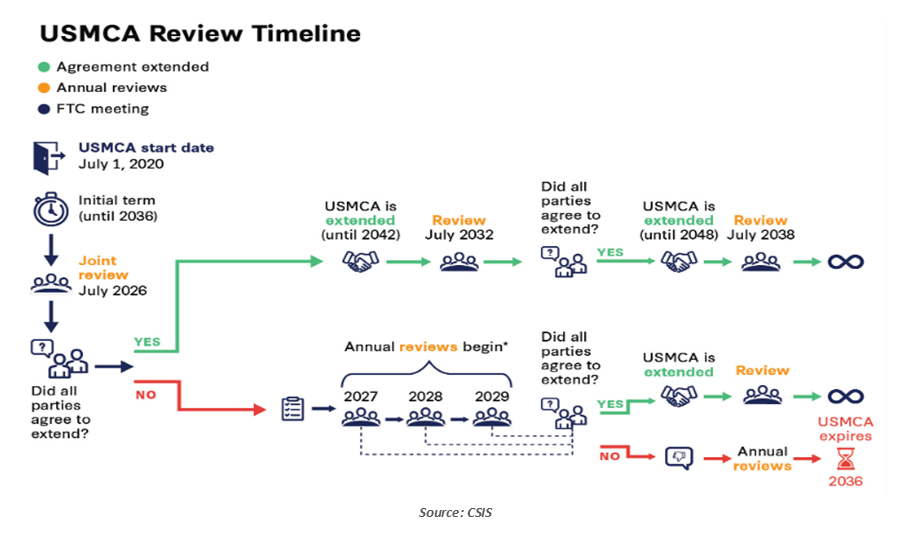
That image of coordination is striking because, off the pitch, the region’s most important partnership may enter a far less harmonious phase. Just as the three co-hosts welcome the world together, the United States-Mexico-Canada Agreement (USMCA) is heading into its first mandatory joint review on July 1. The agreement does not expire if it is not extended; instead, it sets off annual reviews, and can remain in force for up to a decade unless one country formally exits. That reduces the odds of a sudden collapse, but not the stakes surrounding the negotiations.
Rolling annual reviews could prove as disruptive as a formal rupture.
The review process can broadly evolve along three paths. The first is that the pact is preserved with limited changes. This would restore policy clarity and maintain broad market access. While still possible, this outcome looks less likely given the U.S. administration’s stance.
The second, and the most plausible, is a status quo with no formal renewal, triggering annual reviews. In this case, the agreement stays in place, and many USMCA-compliant goods continue to move without much friction. While it would retain current terms, recurring negotiations would insert uncertainty in the system. Sector-specific issues will return to the forefront repeatedly.
The third, worst-case scenario is a breakdown, where one or more parties ultimately step away. That would mean a loss of exemptions, higher tariffs, and disruptions to deeply integrated supply chains built over decades. While outright termination of the USMCA during this review cycle remains unlikely, uncertainty alone could prove to be nearly as damaging as a full rupture for future business, trade and investment plans.
For the U.S., the review is about reducing trade imbalances and aligning trade policy with industrial strategy. America’s trade deficit with Mexico stood at over $200 billion in 2025 and just above $50 billion with Canada. Policy is increasingly also tied to strategic competition, particularly with China.
The auto sector remains at the center of discussions. The U.S. administration is pushing for new vehicles to contain at least 50% American content to qualify for tariff-free treatment, as it seeks to reshore production and jobs. Since both Canada and Mexico rely heavily on imported products, including from China, concerns about transshipment and indirect market access are likely to feature prominently in negotiations.
For Mexico, trade with its northern partners accounts for 44% of GDP, with total USMCA trade exceeding $800 billion. The country is highly dependent on U.S. demand, which absorbs 83% of its exports. The agreement has broadly worked in Mexico’s favor, supported by lower labor costs, a deep manufacturing base and proximity to the U.S. market. Mexico has strengthened its position as a hub for assembly and integration within regional supply chains, including in technology-linked sectors. A stable USMCA framework would reinforce this momentum.
Canada’s dependence on the U.S. market remains substantial, with about 77% of its goods exports heading south of the border. While Canada still enjoys preferential access, that edge is eroding as the rules evolve. The country’s strengths lie in its resource base like energy, agriculture and critical minerals, where it remains strategically important. However, its footprint in next-generation industries is relatively limited. As U.S. demand increasingly tilts toward electronics, AI-driven supply chains and advanced manufacturing, Canada risks being underrepresented in the fastest-growing segments of commerce.
Without USMCA renewal, North America’s competitive edge will gradually erode.
Canada and Mexico would bear the larger direct burden from any USMCA disruption given their dependence on U.S. trade. Reduced market access would hit export growth, manufacturing employment and investment flows. Mexico, already under strain, lost 300,000 auto sector jobs last year and has seen 19 straight months of negative total investment. Wary of jeopardizing the trade pact, it has raised tariffs on a wide range of Chinese imports, including steel and electric vehicles.
Trade uncertainty is already weighing on Canada. Its exports base is concentrated in sectors such as autos, metals, machinery and wood products. This leaves it exposed to targeted tariffs, tighter content rules and shifting policy discretion. Even without a breakdown of USMCA, there is risk of a gradual loss of market access. Efforts to broaden trade ties to countries like China risk adding friction to an already sensitive negotiating dynamic with America.
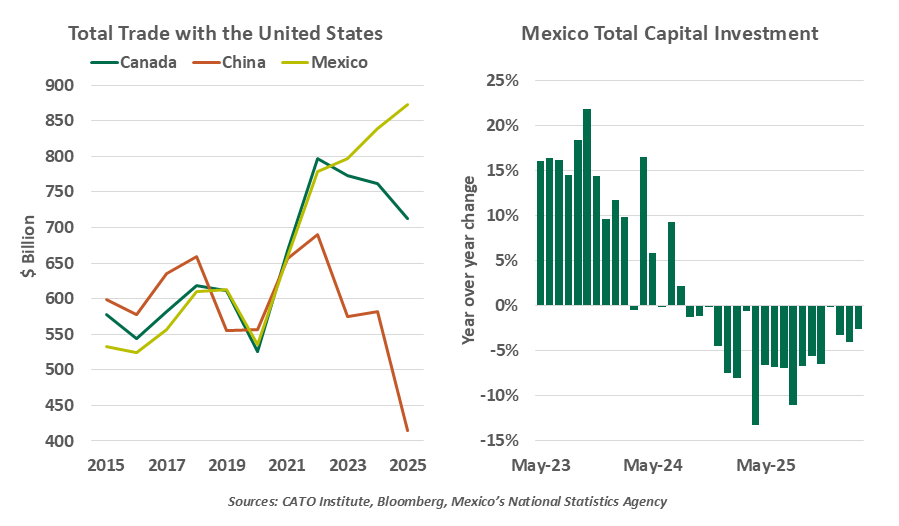
American firms will not be immune. Canada and Mexico account for roughly one-third of U.S. exports, with shipments to the two countries up 56% since USMCA took effect in 2020. U.S. producers are deeply rooted in North American supply chains, particularly in autos, machinery and agriculture. Stricter domestic content requirements in autos would likely push prices higher. New U.S. vehicles already average more than $51,000; costs would climb further if tariff burdens were passed through more fully. A prolonged period of policy uncertainty or more complex rules would raise production costs and risk weakening export demand for U.S. firms.
Even in the baseline scenario, where the agreement persists but shifts to annual reviews, costs will accumulate. Investment decisions would be delayed or scaled back, because its durability is in question. Over time, this would weigh on productivity and weaken the region’s competitive edge.
The ongoing World Cup showcases three countries working together. The USMCA review will reveal whether that cooperation extends beyond sport. A shared platform can continue to deliver strong outcomes, but only if the rules remain clear, stable and broadly accepted.
Related Articles
Meet Your Expert
Vaibhav Tandon
Chief International Economist
Vaibhav Tandon is the Chief International Economist within the Global Risk Management division of Northern Trust. In this role, Vaibhav briefs clients and colleagues on the economy and business conditions, supports internal stress testing and capital allocation processes, and publishes the bank’s formal economic viewpoint. He publishes weekly economic commentaries and monthly global outlooks.

Meet Our Team


Subscribe to Publications on Economic Trends & Insights
Gain insight into economic developments and our latest forecasts for the United States.
Information is not intended to be and should not be construed as an offer, solicitation or recommendation with respect to any transaction and should not be treated as legal advice, investment advice or tax advice. Under no circumstances should you rely upon this information as a substitute for obtaining specific legal or tax advice from your own professional legal or tax advisors. Information is subject to change based on market or other conditions and is not intended to influence your investment decisions.
© 2026 Northern Trust Corporation. Head Office: 50 South La Salle Street, Chicago, Illinois 60603 U.S.A. Incorporated with limited liability in the U.S. Products and services provided by subsidiaries of Northern Trust Corporation may vary in different markets and are offered in accordance with local regulation. For legal and regulatory information about individual market offices, visit northerntrust.com/terms-and-conditions.