
Weekly Economic Commentary | May 1, 2026
OPEC Loses a Key Player
The UAE's breakout may challenge other oil producers.
By Vaibhav Tandon, Ryan Boyle
Students of game theory often start with a lesson in the prisoner’s dilemma: two agents would gain a better collective outcome by cooperating, but each has an individual incentive to take action that is at their partner’s expense. Since 1960, the Organization of the Petroleum Exporting Countries (OPEC) has been an example of successful, mutually beneficial cooperation, even helping to stabilize the global economy. This week, it became an illustration of how individual actions can come at the expense of others.
OPEC is an intergovernmental organization that coordinates oil production among its 12 member states to ensure stable supply, predictable revenues and fair investment returns. Ten additional nations, known as OPEC+, are not members but do align their production with the core cohort. As this entry goes to press, the membership has declined by one.
The United Arab Emirates’ (UAE) decision to withdraw from OPEC and OPEC+, effective with only four days notice, is significant given its scale and role. The move carries implications for both producers and consumers.
Output within OPEC is dominated by Saudi Arabia. The UAE, while the fourth‑largest producer, holds the second‑largest spare capacity. This makes the country a key swing state, capable of easing price pressures.
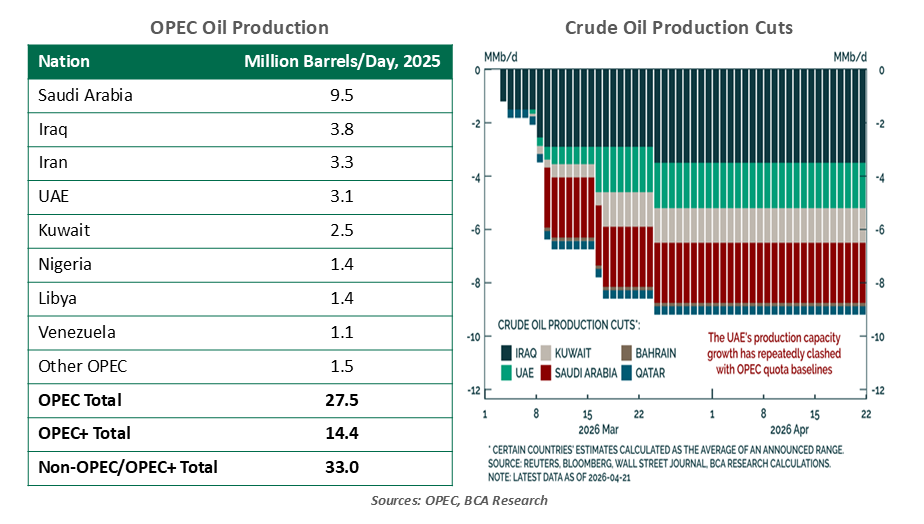
The UAE’s exit may have been triggered by years of tension, particularly with Saudi Arabia, over quota baselines that clashed with its production capacity. The UAE invested heavily to expand its oil industry and grow its market share, but OPEC limits have repeatedly held it back. The pain of those rules has become more acute, as the UAE has a pipeline to ship oil to the Gulf of Oman, bypassing the contentious Strait of Hormuz.
Under quotas, UAE production has been capped at roughly 3-3.5 million barrels per day (bpd), despite capacity nearing 4.8 million bpd. The UAE plans to ramp up output further to around 5 million bpd by next year. In contrast, Saudi Arabia was supplying about 10 million bpd before the conflict in Iran forced a 20% reduction. These constraints meant the UAE was bearing a disproportionate share of the revenue sacrifice required to sustain OPEC discipline.
OPEC’s importance to world oil markets has diminished from about a 60% share of internationally traded oil in the 1970s to 35% today. Oil is also less critical to the world economy than it was in the 1970s. But OPEC’s announcements still had the power to move global oil prices, as the cartel could credibly coordinate output among its members. The UAE’s exit has raised questions about that discipline.
OPEC’s grip on oil markets is loosening.
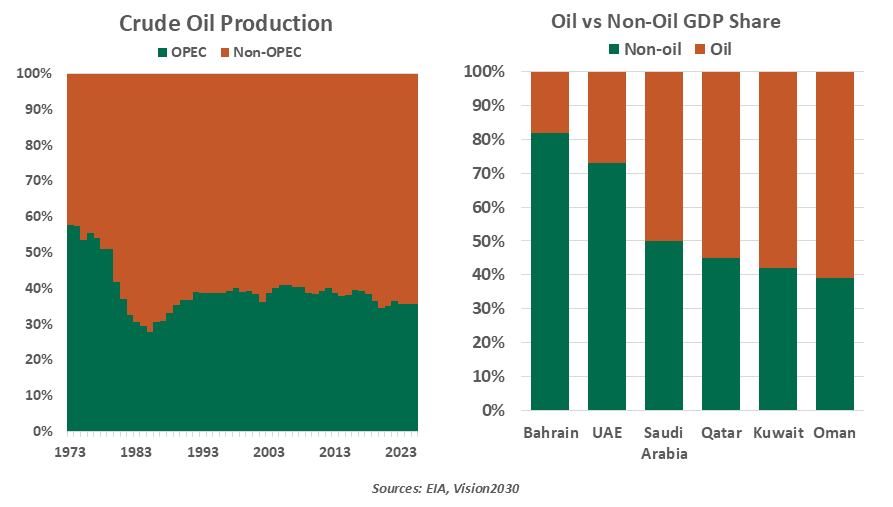
Saudi Arabia could respond by deepening cuts or, in a more extreme scenario, engaging in a price war. Given its already diversified economy, the UAE could better withstand lower prices than other OPEC members. Saudi Arabia’s fiscal breakeven oil price is higher than that of its peers. The Kingdom may be forced to scale back spending on some of its ambitious projects, potentially hampering diversification efforts.
While an immediate breakdown of OPEC is unlikely, internal strains are clearly rising. A weaker alliance raises the risk of a domino effect. Larger producers may see a greater reward for testing or leaving the alliance. As they ponder their future, oil exporters should bear in mind the prisoner’s dilemma: Each participant acting in their own interest creates an outcome with everyone worse off.
Related Articles
Meet Our Team



Subscribe to Publications on Economic Trends & Insights
Gain insight into economic developments and our latest forecasts for the United States.
Information is not intended to be and should not be construed as an offer, solicitation or recommendation with respect to any transaction and should not be treated as legal advice, investment advice or tax advice. Under no circumstances should you rely upon this information as a substitute for obtaining specific legal or tax advice from your own professional legal or tax advisors. Information is subject to change based on market or other conditions and is not intended to influence your investment decisions.
© 2026 Northern Trust Corporation. Head Office: 50 South La Salle Street, Chicago, Illinois 60603 U.S.A. Incorporated with limited liability in the U.S. Products and services provided by subsidiaries of Northern Trust Corporation may vary in different markets and are offered in accordance with local regulation. For legal and regulatory information about individual market offices, visit northerntrust.com/terms-and-conditions.