Tax News You Can Use | For Professional Advisors

Jane G. Ditelberg
Chief Tax Strategist
Updated October 2026
If you’ve met IRMAA — the Income-Related Monthly Adjustment Amount — you probably wish you hadn’t. IRMAA is a surcharge to Medicare premiums for higher-income retirees with Medicare Part B and/or Part D. These surcharges are on top of the standard premium for Medicare Part B ($202.90 in 2026) and the insurance carrier’s premium cost for individuals with Medicare Part D. When applicable, IRMAA can more than triple standard Medicare premiums. It often comes as a surprise to those newly eligible for Medicare when they are comparing premiums, as well as to Medicare beneficiaries who have an income change (such as when required minimum distributions for IRAs or qualified plans kick in).
While IRMAA is not a tax, per se, this discussion does belong in the category of tax news because IRMAA is based on the Medicare beneficiary’s Modified Adjusted Gross Income (MAGI), and managing IRMAA exposure means understanding and managing MAGI.
Who pays IRMAA?
IRMAA is a surcharge imposed on taxpayers with MAGI over the annual limit. It was first enacted in 2003 and is based upon the fact that the regular Medicare premiums for Parts B and D do not cover all or even most of the cost. By imposing the surcharge, Congress passed a higher portion of the cost on to higher-income Medicare beneficiaries.
How Is IRMAA Determined?
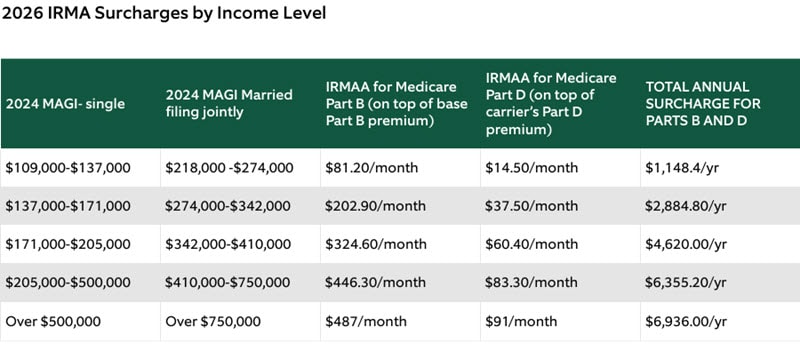
Whether Medicare participants are subject to IRMAA depends on their income for the calendar year that is two years before the surcharge goes into effect. IRMAA surcharges paid for Medicare coverage in 2026 are based on MAGI from 2024 (reported on tax returns filed in 2023). Those who are subject to IRMAA will receive a notice in November of the preceding year (November 2026 for 2027 premiums). For 2026, IRMAA kicked in for Medicare beneficiaries with 2024 MAGI over $109,000 for single taxpayers or $218,000 for those who are married and filing jointly. It is imposed according to the brackets in the chart below, which are often referred to as the “IRMAA cliffs.” Moving from one bracket to another is referred to as “falling off the IRMAA cliff.”
Planning for IRMAA?
For IRMAA purposes, a taxpayer’s MAGI generally consists of wages, taxable interest, ordinary dividends, taxable IRA or qualified plan distributions, taxable pension payments, taxable Social Security benefits, capital gains, and tax-exempt interest. Keeping that definition in mind, there are steps a taxpayer can consider to reduce or eliminate exposure to IRMAA surcharges through the timing of income and other planning opportunities. Consider the following:
- Distributions from Roth IRAs are not taxable income. If a Medicare participant can convert their traditional IRA to a Roth IRA more than two years before enrolling in Medicare, they will be able to reduce their taxable income. On the other hand, doing a Roth conversion (which involves paying the tax on the assets that were rolled over from a traditional IRA) while enrolled in Medicare or in the preceding two years will increase MAGI and may trigger the IRMMA surcharge or increase the amount.
- Using a qualified charitable distribution (QCD) from a traditional IRA to make charitable gifts, rather than withdrawing assets from the IRA first and then giving them, can reduce exposure to IRMAA. A QCD results in no taxable income and can count as the owner’s RMD. Therefore, it will reduce MAGI and, thereby, exposure to IRMAA.
- Since MAGI includes capital gain, those applying for Medicare may wish to consider strategies to reduce the recognition of capital gains. These could include borrowing against appreciated assets rather than selling them, tax loss harvesting, or avoiding investments in mutual funds that generate capital gains on a regular basis.
- Sometimes, a taxpayer can choose the tax year in which income will be recognized or deductible expenses are paid. Running the numbers can reveal whether it is more advantageous to bunch income into a single year or spread it over multiple years. Would it be better to pay IRMAA at a higher level for one year (bunching income) or be in a lower bracket for multiple years (spreading income out)? Deferred compensation and Inherited IRAs subject to the 10-year rule are examples of planning opportunities.
What If Circumstances Change?
Because IRMAA applicability is determined based on MAGI from two years earlier, there are sometimes extenuating circumstances that arise between the MAGI determination and the date the IRMAA surcharge applies. If a Medicare beneficiary has experienced any of the life events specified below between the MAGI determination and the time at which the surcharge must be paid, the beneficiary can seek an IRMAA redetermination. These life events are:
- Marriage
- Dissolution or annulment of marriage
- Death of spouse
- Work stoppage
- Work reduction
- Loss of income-producing property
- Loss of pension income or employer settlement payments due to closure or bankruptcy of the employer
Medicare participants who have experienced one of these life events can seek a redetermination by filing form SSA-44 with the Social Security Administration, or by contacting their local Social Security office. For redetermination requests that are not tied to a specified life event, there is a 60-day window to complete the request. If it is denied, the participant can file a formal appeal through the Office of Medicare Hearings and Appeals.