'%3e%3cpath%20d='M14.5584%2010.5857L23.6652%200H21.5072L13.5999%209.19156L7.2843%200H0L9.55034%2013.8992L0%2025H2.1582L10.5087%2015.2935L17.1783%2025H24.4626L14.5582%2010.5857H14.5588H14.5584ZM11.6025%2014.0215L10.6348%2012.6375L2.9357%201.62451H6.25036L12.4638%2010.5123L13.4315%2011.8963L21.5082%2023.4491H18.1935L11.6027%2014.0219V14.0213L11.6025%2014.0215Z'%20fill='%23808182'/%3e%3c/g%3e%3cdefs%3e%3cclipPath%20id='clip0_20_84'%3e%3crect%20width='24.4624'%20height='25'%20fill='white'/%3e%3c/clipPath%3e%3c/defs%3e%3c/svg%3e)
%20is%20a%20leading%20provider%20of%20wealth%20management,%20asset%20servicing,%20asset%20management%20and%20banking%20to%20corporations,%20institutions,%20affluent%20families%20and%20individuals.%20Founded%20in%20Chicago%20in%201889,%20Northern%20Trust%20has%20offices%20in%20the%20United%20States%20in%2019%20states%20and%20Washington,%20D.C.,%20and%2020%20international%20locations%20in%20Canada,%20Europe,%20the%20Middle%20East%20and%20the%20Asia-Pacific%20region.%20%3c/desc%3e%3cpath%20fill='%233d4042'%20d='M21,21H17V14.25C17,13.19%2015.81,12.31%2014.75,12.31C13.69,12.31%2013,13.19%2013,14.25V21H9V9H13V11C13.66,9.93%2015.36,9.24%2016.5,9.24C19,9.24%2021,11.28%2021,13.75V21M7,21H3V9H7V21M5,3A2,2%200%200,1%207,5A2,2%200%200,1%205,7A2,2%200%200,1%203,5A2,2%200%200,1%205,3Z'%3e%3c/path%3e%3c/svg%3e)
%20-%20https://sketch.com%20--%3e%3ctitle%3eEmail%3c/title%3e%3cdesc%3eShare%20article%20via%20email%3c/desc%3e%3cg%20id='Article'%20stroke='none'%20stroke-width='1'%20fill='none'%20fill-rule='evenodd'%3e%3cg%20id='article-desktop'%20transform='translate(-291.000000,%20-905.000000)'%20fill='%233d4042'%20fill-rule='nonzero'%3e%3cg%20id='Group-3'%20transform='translate(280.000000,%20700.000000)'%3e%3cpath%20d='M12.5859376,205%20L25.5,216.098563%20L38.4140625,205%20L12.5859376,205%20Z%20M11,206.352162%20L11,221.582916%20L19.5446429,213.697123%20L11,206.352162%20Z%20M40,206.352162%20L31.4553572,213.697123%20L40,221.582916%20L40,206.352162%20L40,206.352162%20Z%20M21.1197917,215.049268%20L12.5212054,223%20L38.4787946,223%20L29.8802084,215.049268%20L26.1688988,218.240388%20C25.7827601,218.567837%2025.21724,218.567837%2024.8311012,218.240388%20L21.1197917,215.049268%20L21.1197917,215.049268%20Z'%20id='Shape'%3e%3c/path%3e%3c/g%3e%3c/g%3e%3c/g%3e%3c/svg%3e)
'%20fill='%233d4042'%20fill-rule='nonzero'%3e%3cpath%20d='M317.048444,961%20C318.677807,961.001791%20319.998224,962.333083%20320,963.975866%20L320,963.975866%20L320,972.789759%20C320,973.478748%20319.446027,974.037283%20318.762667,974.037283%20L318.762667,974.037283%20L313.420222,974.037283%20L313.420222,980.619276%20C313.466211,981.335082%20312.928257,981.953082%20312.218333,982%20L312.218333,982%20L298.781667,982%20C298.071743,981.953082%20297.533789,981.335082%20297.579778,980.619276%20L297.579778,980.619276%20L297.579778,974.037283%20L292.237333,974.037283%20C291.553973,974.037283%20291,973.478748%20291,972.789759%20L291,972.789759%20L291,963.975866%20C291.001776,962.333083%20292.322193,961.001791%20293.951556,961%20L293.951556,961%20Z%20M311.486889,970.525371%20L299.513111,970.525371%20L299.513111,980.050743%20L311.486889,980.050743%20L311.486889,970.525371%20Z%20M314.395276,962.742345%20C313.970645,962.65481%20313.549254,962.905694%20313.420222,963.322865%20C313.394809,963.404999%20313.380715,963.490265%20313.378333,963.576269%20C313.380722,963.661209%20313.394821,963.7454%20313.420222,963.826423%20C313.529012,964.18316%20313.855609,964.426832%20314.225778,964.427444%20C314.659193,964.427644%20315.022348,964.096906%20315.066078,963.66215%20C315.109809,963.227395%20314.819907,962.829881%20314.395276,962.742345%20Z%20M317.130097,962.784571%20C316.813535,962.651298%20316.448506,962.723595%20316.20547,962.967701%20C315.962434,963.211807%20315.889338,963.579564%20316.020315,963.899239%20C316.151293,964.218915%20316.460504,964.427444%20316.803556,964.427444%20L316.803556,964.427444%20C317.274992,964.425655%20317.651006,964.045094%20317.651006,963.576269%20C317.652304,963.230394%20317.44666,962.917844%20317.130097,962.784571%20Z%20M311.783656,955%20C312.500482,955.040538%20313.043667,955.574507%20312.997231,956.192982%20L312.997231,956.192982%20L312.997231,959%20L297.002769,959%20L297.002769,956.192982%20C296.956333,955.574507%20297.499518,955.040538%20298.216344,955%20L298.216344,955%20Z'%20id='icon-print'%3e%3c/path%3e%3c/g%3e%3c/g%3e%3c/svg%3e)

Jane G. Ditelberg
Chief Tax Strategist
The books are closed on 2025 — or are they? The judicious use of the “65-day rule” can help you reduce last year’s overall tax liability for income earned by estates and trusts.
If you are like most taxpayers, you use a standard calendar-year basis for reporting income taxes. This means that most of the decisions that will affect your 2025 tax return were made sometime between January 1 and December 31 of last year. However, the Internal Revenue Code permits estates and certain trusts to elect to treat income and certain principal distributions made to beneficiaries on or before March 6, 20261 as having been made in 2025.2 In other words, decisions about how to allocate income can be made after the fact. This is known as the 65-day distribution election, and it is important because using it wisely can create meaningful savings in the overall tax liability for trust income. Below, we answer five questions we commonly receive about this rule.
What is a 65-day distribution election, and who can use it?
In general, income retained inside of a trust is taxed to the trust. Income (generally excluding capital gains) that is deemed available for distribution — known as distributable net income (DNI) — that is paid out to a beneficiary under the terms of the trust and applicable state law is deductible by the trust on its tax return. This income is reported to the beneficiary on a form K-1 and is included on the beneficiary’s personal tax return, thereby allowing the trust to act as a conduit for income tax purposes, avoiding double taxation.
The 65-day election comes into play for trustees of non-grantor trusts that have the discretion to make distributions to one or more beneficiaries. However, this election is not applicable to income from a grantor trust, which is taxed directly to the grantor, or a simple trust, which must pay all of the DNI (and only the DNI) out to the beneficiary.
When does distributing income to a trust beneficiary make the most economic sense?
For many trusts, distributing all of the trust’s DNI to the beneficiary is a way to reduce the overall tax burden to affected parties. To see why, consider how income tax brackets for estates and trusts are compressed in comparison to individual filers. For example, in 2025, a trust with income in excess of $15,650 is subject to tax at the highest marginal rate of 37%, while a single taxpayer must have income in excess of $626,350 to be taxed at the same rate. Furthermore, the 3.8% net investment income tax (NIIT) hits trust income in excess of $15,650, while that tax kicks in for single taxpayers making over $200,000. Assuming other factors are not at issue (see question 5), shifting income to the beneficiary subjects that income to a lower effective tax rate.
How can the 65-day distribution election be used to reduce my overall income tax liability?
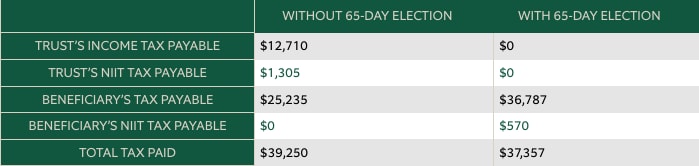
The 65-day election allows a trustee to fully account for all items of income booked in the prior year before making the election. For example, suppose a trust earned taxable DNI4 of $65,000 throughout 2025, but $50,000 of that was received by the trust on December 30, and there was not time to process a distribution of that receipt to the beneficiary until January 2026. Under the terms of the trust, the trustee may make distributions based on the beneficiary’s best interest at the trustee's discretion.5 Assuming the beneficiary is single, takes the standard deduction, has $150,000 in net income taxable at ordinary rates6 for 2025 exclusive of trust distributions, and the trust distributed $15,000 in 2025 and $50,000 before March 6, 2026, the following table compares the federal income taxes due:
How does an executor or trustee make a 65-day distribution election?
To be eligible for this tax treatment, the trustee must complete two steps. The first is that trust income must be distributed to the beneficiary in the first 65 days of the new year: For 2026, the deadline is March 6. The second step is to affirmatively make the election on the trust’s or estate’s income tax return (form 1041), which must be timely filed, including extensions. This election is made by checking the box for question 6 under “other information” found on page three of the current version of form 1041. Importantly, the election is irrevocable once it is made.
What other factors should I consider?
There are a number of additional considerations that may affect a decision to use the 65-day distribution election. Some common considerations include:
State tax consequences: If the beneficiary is subject to state income tax but the trust is domiciled in state jurisdiction with lower income tax rates (or no income tax at all), shifting income recognition to the beneficiary may not be prudent.
An incomplete picture of prior year income: If the beneficiary has private investment holdings that provide tax information after the March 6 election deadline, the trustee may not have sufficient information in time to make an election.
A net disadvantage of additional beneficiary income: Additional beneficiary income could adversely impact Medicare Parts B and D premiums, the ability to make Roth IRA contributions or eligibility for a variety of other deductions or credits.
Clearly, there are numerous other considerations that could affect a decision to use the 65-day election. Because a trustee is a fiduciary — with a duty to act in the best interests of the beneficiaries — the trustee must take care to weigh all relevant factors unique to the beneficiary’s situation. As such, we recommend that you consult with your advisors when considering a 65-day election in the context of your overall wealth plan.
%20scale(1,%20-1)%20rotate(-90.000000)%20translate(-22.445237,%20-21.357547)%20'%20points='21.2928054%2010.2071946%2022.707019%208.79298104%2030.8809213%2016.9668834%2015.4904479%2033.9221138%2014.0095521%2032.5778862%2028.119%2017.034'%3e%3c/polygon%3e%3c/g%3e%3c/svg%3e)